Water
How Long to Boil Water to Make It Safe
One minute at a rolling boil kills the germs that make people sick. At high altitude it takes three, and in a long outage the fuel runs out before the patience does.
Bring clear water to a rolling boil and hold it there for one full minute. Above 6,500 feet the CDC says three minutes, and the EPA sets the line lower, at 5,000 feet, so anyone living between those two heights should use three.
That one minute is enough because the boil itself does the work. The World Health Organization's technical brief on boiling says that heating water to a rolling boil is sufficient to inactivate bacteria, viruses and protozoa, and the EPA's emergency disinfection guide builds its instructions on that brief. What the minute cannot do is take out chemicals, metals or salt, and in a grid-down month the harder question is often how many gallons your fuel will cover.
Your next step: look at the fuel you actually have tonight, whether that is propane cylinders, a grill tank or a woodpile, and work out how many gallons a day your household drinks. The fuel section below turns that into pounds of propane.
Does boiling water purify it?
It disinfects it, which is what most people mean by the question. Boiling kills or inactivates the living things in water: the bacteria behind diarrheal illness after a flood, the viruses that ride in sewage overflows, and the protozoa such as Giardia and Cryptosporidium that come from animal waste in creeks and ponds. The CDC's boil-water advisory calls boiling the surest way to kill the germs in water, viruses, bacteria and parasites alike, and a pot needs no special gear to deal with Cryptosporidium. Chlorine struggles with that parasite, which is why our bleach purification guide sends creek water through a filter or a pot as well.
Purify is a bigger word than disinfect, though. Boiling leaves everything that is not alive exactly where it was, and the section on what boiling leaves in the water lists what that includes. For tap water under a boil-water notice, a broken main or a pressure loss, disinfection is all the water needs. For floodwater, ditch water or anything that smells of fuel, it is only half the job.
When a rolling boil starts the clock
A rolling boil is the point where big bubbles rise from the whole bottom of the pot and break across the entire surface, and keep breaking when you stir. Small bubbles clinging to the sides, or a lazy simmer that stops the moment you stir, come well before it. The one-minute count starts once the boil is rolling, never at the first wisp of steam.
The full sequence the EPA gives is short:
- Let cloudy water settle, then pour it through a clean cloth, a paper towel or a coffee filter.
- Bring it to a rolling boil with the lid on, which gets it there faster and on less fuel.
- Hold the boil for one minute, or three at altitude, lid off or cracked so it does not boil over.
- Let it cool on its own, covered, in the same pot.
- Pour it into clean containers with lids and close them.
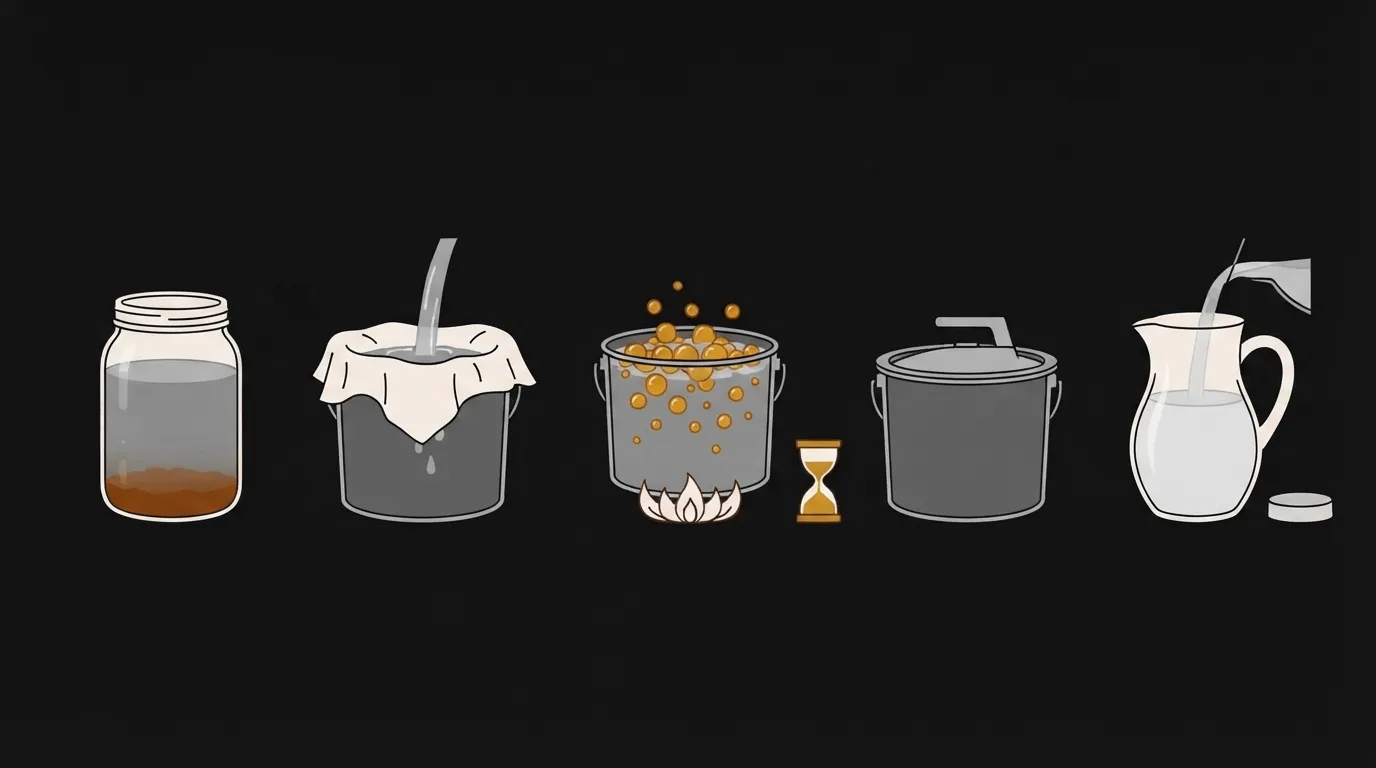
Straining first matters more than it looks. Silt and leaves do not make the boil less effective at killing germs, but they make the water taste of the creek and they clog any filter you run it through later. A coffee filter rubber-banded over the mouth of a jug costs nothing and catches most of it.
Boiling water at high altitude
Water boils at a lower temperature the higher you live, roughly one degree Fahrenheit lower for every 500 feet of climb. At sea level it boils at 212°F. In Denver it boils close to 202°F, and at 8,000 feet in the Rockies it is near 196°F. Germs die from heat over time, so cooler boiling water needs longer to do the same job. That is the whole reason for the three-minute rule.
The two agencies draw the line in different places. The CDC's boil-water advisory says to boil for three minutes at elevations above 6,500 feet. The EPA's emergency page says three minutes above 5,000 feet. Neither one is wrong for its own audience, and the cost of the stricter rule is two extra minutes of flame. I would use the EPA line: if your county sits anywhere above 5,000 feet, boil for three minutes and stop thinking about it. Your elevation is on a topographic map, a phone's compass app or the county's own website.
Altitude does not change anything else on this page. The settling, the cooling and the storage all work the same at 7,000 feet as at the coast. Fuel does go a little further up high, since the water only has to reach a lower temperature, but the extra two minutes of boiling eat most of that saving.
How to boil water without power
Any flame that will hold a pot works, as long as it burns outdoors or in an appliance built to burn indoors. Camp stoves, propane grills, charcoal grills and turkey fryers make carbon monoxide, and running one in a kitchen, a garage or on an enclosed porch is how outage cooking turns fatal. Our carbon monoxide guide covers the same danger for generators, and the distances and alarms in it apply to every fuel-burning appliance on this list.
- A propane camp stove, outside on a table out of the wind. The one-pound green cylinders are easy to store, and an adapter hose lets the stove run off a 20-pound grill tank instead.
- A gas grill's side burner, or the grill itself with the pot on the grate and the lid closed. The main burners waste heat around the pot, so the side burner is the better use of the tank.
- A wood stove, indoors, the one appliance on this list made to burn inside. A covered pot on the hottest part of the top plate will reach a rolling boil once the stove is running hot. Our page on woodstove cooking explains how to find the hot spots on the plate.
- An open fire or a fire pit, outdoors, with the pot on a grate or hung from a tripod. It works, and it is the slowest and most wasteful of the five.
- A gas kitchen range whose igniter is dead because the power is off. Many can be lit with a match, and the owner's manual says whether yours is one of them and how to do it safely.
A portable power station can run an electric kettle, but each gallon needs at least 0.37 kilowatt-hours of heat before any losses. That is a large bite out of a battery the household also needs for the fridge, lights and phones, so I would keep it for the morning coffee and boil the drinking water on a flame.
How much fuel it takes to boil a gallon
Here the arithmetic matters more than the minute. A gallon of water weighs 8.34 pounds, and raising it from a 60°F tap to 212°F takes about 1,270 BTU. Propane holds about 21,500 BTU per pound. If a stove got every bit of that heat into the pot, one pound of propane would boil nearly 17 gallons. No stove comes close. If half the heat reaches the water, which is a fair figure for a camp stove with a lid on the pot and no wind, a pound boils about 8 gallons.
Measured figures run lower. A stove-efficiency summary from outdoors.nordling.de puts a typical stove at 0.64 to 0.81 ounces of propane per liter boiled in still air, which works out to about 5 to 6.5 gallons per pound. Wind is the big variable. Battlbox's fuel guide describes a stove that boils in three minutes in a garage taking nine in a 10 mph breeze, three times the fuel for the same pot. I would plan on 5 gallons a pound and treat anything better as a bonus.
| Propane on hand | Gallons boiled | Days for 4 people |
|---|---|---|
| One 1-lb cylinder | about 5 | 1 |
| Six 1-lb cylinders | about 30 | 7 |
| One 20-lb tank | about 100 | 25 |
| Two 20-lb tanks | about 200 | 50 |
The days column assumes four people drinking a gallon each a day, the Ready.gov baseline, and boiling every drop of it. It leaves out cooking, which on most camp stoves uses as much fuel again. A full 20-pound tank is three to four weeks of drinking water for a family of four, then, and a shelf of one-pound cylinders is a long weekend. That gap is why boiling works as the method for a short boil order and as one leg of a plan for a long outage, with stored water and bleach carrying the rest.
Wood is harder to put numbers on, because an open fire loses most of its heat to the air around the pot. A stove already burning to heat the house is a different case: the pot on top rides on fuel you were spending anyway, which makes it the cheapest boil in a winter outage. Seasoned wood matters for the same reason. Illinois Extension rates white oak at about 26.5 million BTU a cord against 16.1 for cottonwood, and wet wood spends its heat drying itself out first. Our guide to seasoning firewood covers the drying.
A few habits stretch any fuel. Boil the biggest pot you have, since the one-minute hold costs the same for two gallons as for one. Keep the lid on until the water rolls. Block the wind with a stove screen, a box or the side of the house. And start with the warmest water you have, such as a jug that sat in the sun, because every degree it starts higher is heat the fuel does not have to supply.
Cooling, storing and fixing the flat taste
The EPA says to let boiled water cool naturally and store it in clean containers with covers. Leave the lid on the pot while it cools, and do not add ice or cold water to hurry it, since either one brings back whatever the boil just killed.
Boiled water carries no leftover disinfectant, unlike chlorinated tap water or bleach-treated water, so it is only as clean as the container it goes into and the hands that touch it. Rinse containers with the bleach solution in our bleach guide, pour rather than dip a cup into the jug, and keep the lids closed between uses. I would boil a day's water at a time in an outage instead of filling a week of jugs at once, so nothing sits open long enough to pick up germs again.
Boiled water tastes flat because the boil drives off the dissolved air. The EPA's fix is to pour it back and forth between two clean containers several times, or to add a pinch of salt to each quart. Pouring is the better one for anyone watching their salt. Boiled water also makes an easy start for powdered milk, drink mixes and the morning coffee, which hide the taste completely.
For water you mean to store for months rather than drink this week, boiling is the slow way around. City tap water poured into clean containers keeps without any treatment, and our pages on how much water to store per person and filling and rotating 55-gallon drums cover that side of the plan.
What boiling leaves in the water
The CDC's advisory says plainly that boiling does not remove chemicals, and the EPA lists heavy metals, salts and most other chemicals as untouched by boiling or disinfection. Lead from old pipes, nitrate from fertilized fields, fuel from a flooded gas station, salt from storm surge and pesticides from farm runoff all come out of the pot just as they went in.
Some come out worse. Boiling drives off water as steam and leaves everything dissolved in what is left, so a long boil makes chemical contamination a little more concentrated, never less. That is one more reason to hold the boil for the minute and no longer.
Boiling also does nothing for silt, color or smell beyond what the strainer catches. Water with floating material, a dark color or an odor is water the EPA says to skip in favor of a better source. Ready.gov names distillation as the method that does remove metals, salts and most chemicals: boil the water and catch the steam as it condenses, which takes far more fuel and time than boiling alone. For most households the better answer is a cleaner source and a filter whose rating covers the problem.
Boil, bleach or filter: which water gets which
Each method has the water it suits. City water under a boil order gets boiled if fuel allows, or dosed with bleach if it does not. Rain barrel water and the water in a drained water heater can go either way. Creek, pond and spring water picks up Cryptosporidium from animals, so it gets boiled, or filtered and then chlorinated. Floodwater and anything near fuel or farm chemicals gets left alone if any other source is within reach, because neither heat nor chlorine touches what makes it dangerous.
Where boiling clearly wins is the water nobody can vouch for, in small amounts. Where it loses is volume. Treating 30 gallons for a family's week with bleach costs a few teaspoons. Boiling the same 30 gallons burns about six pounds of propane, close to a third of a grill tank.
My take: where boiling fits in a water plan
I would treat boiling as the method for the water you are about to drink, and never as the plan for the whole supply. Stored tap water carries the first two weeks. Bleach handles volume. A filter covers creek water and the parasites chlorine misses. The pot covers everything else in small batches, and it is the method to trust most when you do not know where the water has been.
For the fuel, I would keep one full 20-pound propane tank set aside for water and cooking only, never used up on summer barbecues, plus a two-burner stove and the adapter hose to run it off that tank. A household that heats with wood already has its winter fuel for boiling covered and should spend the money on dry wood. Write "one minute rolling, three above 5,000 feet" on a card and tape it inside the lid of the water bin.
The rest of the water section covers storage, sources and the other treatment methods.
