Old ways
Splitting and Seasoning Firewood
How to turn green rounds into wood that lights fast, heats the room and leaves the chimney clean: when to cut, how to split by hand, how to stack, and how to tell when it is ready.
To season firewood, cut it to stove length, split it while it is still green, and stack it outdoors in loose rows off the ground with only the top covered. Give it at least six months, and closer to two years for oak, until a freshly split face reads under 20 percent moisture.
Wet wood is the most common reason a wood stove lets a household down in a winter outage. It smokes, it struggles to catch, it never gets a room properly warm, and it coats the chimney with creosote at the very time nobody wants a chimney fire. Good firewood is made the year before you burn it, so the work you do this spring decides how warm the house is next January.
Why wet wood fails you
A living tree carries a great deal of water in its wood, and cutting it down does not remove any. Before any of the wood can burn, that water has to boil off inside the firebox, and the fire pays for it. Doug McLaren, a forestry specialist with the University of Kentucky Cooperative Extension Service, put it plainly: if the wood is not properly seasoned, most of the heat it makes goes into drying the wood itself, and only dry wood sends the majority of its heat into the house.
The steam also cools the fire. A cool, smoldering fire sends unburned smoke up the flue, where it condenses on the cold chimney walls as creosote. Illinois Extension calls chimney fires one of the biggest safety concerns with wood burning and names seasoned wood and hot fires as the first defenses against creosote. A poor draft from a smoky fire can also push smoke back into the room.
In an ice storm or a long blackout, every one of those problems lands at once. You burn more wood for less heat, you tend the stove constantly, and you build up a chimney hazard with no fire department coming quickly. Dry wood fixes all of it before the first match.
How long to season firewood
The short official answer is six months as a minimum. The EPA's Burn Wise guidance says to season wood for at least six months and that it burns best below 20 percent moisture. Illinois Extension says it usually takes six to nine months after cutting to get there. Those figures assume the wood is split and stacked in the open. A pile of unsplit rounds in the shade can sit for years and still hiss.
Species changes the answer more than anything else. Dense hardwoods hold their water longer. Firewood for Life suggests about a year for most firewood and notes that oak sometimes takes two. Lighter woods such as pine, poplar and soft maple dry fastest, which is also why they burn faster and give less heat per load. Climate shifts it again: a summer of dry wind in Colorado does more than a damp one in the Pacific Northwest, and the same wood split in March is drier by November than wood split in August.
As a working rule for a household planning ahead:
- Softwoods and light hardwoods such as pine, spruce, poplar, cottonwood and soft maple: split in spring, burnable that winter.
- Mid-weight hardwoods such as ash, cherry, hard maple and birch: about a year in the stack.
- Oak and hickory: plan on two summers, and test before you burn.
Kentucky's advice is to start in spring. Wood cut and split as the weather warms gets the whole drying season of sun and wind, and that one decision about timing does more than any stacking trick.
Splitting firewood by hand
Splitting does two jobs. It makes rounds small enough to carry and load, and it opens the wood up so it can dry. Bark slows the loss of water, and the cut ends and fresh split faces are where most of it leaves. Firewood for Life compares an unsplit round to a rolled-up wet towel that stays damp inside for weeks. Split the wood green, soon after cutting. Waiting for rounds to dry first only slows the whole process down.
The tools are old and simple:
- A splitting maul has a heavy, wedge-shaped head that drives a round apart by weight. It is slow and tiring but handles big, tough rounds.
- A splitting axe has a lighter head ground to a wedge and is quicker to swing all afternoon. It suits straight-grained wood of moderate size.
- Steel wedges and a sledge take over when a round is too knotty or too wide for a single blow. Never strike a steel wedge with the back of an axe, which can crack the eye.
A felling axe, with its thin blade, is the wrong tool. It sticks in the wood rather than pushing it apart.
Technique and safety at the block
Set each round on a chopping block, a wide, flat section of a big log, never on the ground. The block keeps the edge out of the dirt and stones, and it stops soft ground from soaking up the blow. Stand the round toward the far side of the block so a miss or a glance lands in the block instead of near your shins.
Stand square with your feet about shoulder width apart. Let the head fall through the wood with your hands sliding together on the handle, and bend your knees as the stroke finishes, so a deflected blow goes into the block or the ground rather than toward your legs. Wear safety glasses, gloves and sturdy boots, and keep children, dogs and helpers well back. Flying halves travel farther than people expect.
Read the round before you swing. Look for checks already running across the end grain and aim into them. On a big round, Firewood for Life advises striking near the outer edge to start a crack and working around it, taking slabs off the sides rather than trying to cleave it through the middle. Knots, branch stubs and forks are the hardest places to split, so turn the round to keep them out of the line of the blow. Some woods simply fight back. The same source rates pine, birch and oak as fair to split and elm as stringy enough to tear rather than part, which makes elm a job for wedges or a hydraulic splitter.
What size to split
Cut rounds a couple of inches shorter than your firebox so they load without jamming. Sixteen inches is the most common length in the United States. For width, Firewood for Life suggests splitting anything larger than a baseball and making most pieces about the size of a loaf of bread. Pieces much thinner than that burn hot and fast. That suits kindling and a cookstove you want to adjust quickly, but it wastes wood in a heating stove you want to hold overnight. Keep a crate of thin splits and kindling aside as you go. In a grid-down winter, getting a fire started quickly every morning matters a great deal.
Stacking firewood to dry
The stack decides how fast wood dries. The EPA puts it in one line: store wood outdoors, off the ground, with only the top covered, because covering the sides traps moisture. Each part of that has a reason.
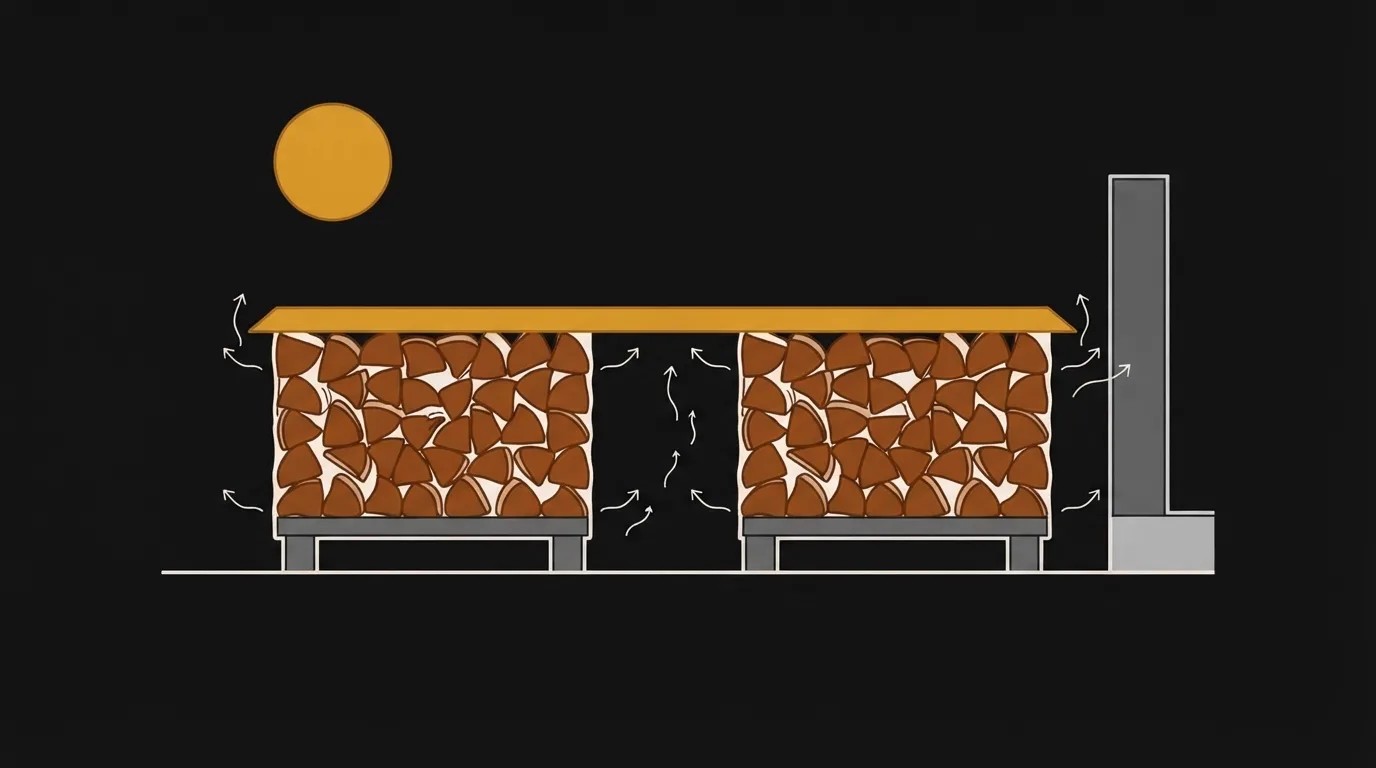
Lift it off the ground. Wood lying on soil wicks up moisture, starts to rot and fills with insects. Two parallel 2x4 runners about a foot apart, or a row of old pallets, lift the bottom course clear. A gravel pad under the runners drains better still.
Leave gaps between the rows. Firewood for Life recommends keeping the stacks about 4 feet high at most for stability, spacing parallel rows 6 to 12 inches apart, and leaving the same gap between a stack and any wall. A single row facing the prevailing wind dries faster than a deep block of wood several rows thick. Crisscrossed ends, laid like a log cabin, hold the row up without posts and let more air in, and a steel T-post driven at each end does the same job.
Cover the top and leave the sides open. A sheet of roofing metal, a few boards or a tarp laid over the top third of the stack sheds rain and snow. A tarp pulled down to the ground turns the pile into a damp tent. A three-sided woodshed with an open front and slatted walls is the best version of the same idea.
Does bark go up or down? People have argued about it for years. Bark up sheds rain, bark down exposes the split face to the sky. The author of Firewood for Life reports stacking both ways and seeing no difference once the stack is raised and roofed, and I would not lose sleep over it either.
Where to put the woodpile
Pick the sunniest, windiest spot you can reach with a wheelbarrow in snow. Shade and still air are what keep wood wet. McLaren of Kentucky Extension also warns against stacking firewood against the house or a wooden fence, because condensation can cause mold and decay on the wall and the fence. Termites, carpenter ants and the spiders that move into woodpiles are a second reason to keep the main stack away from the house.
The working supply is a different matter. Keep the year's wood in the yard and move a smaller covered rack within easy reach of the back door, holding enough for several days of burning. That rack is what you will be grateful for on the night the power goes off in a blizzard and the main stack is under two feet of drifted snow.
If you buy wood, buy it locally. The EPA points readers to the Don't Move Firewood campaign, because firewood hauled from one region to another spreads invasive forest pests such as the emerald ash borer.
How to tell when firewood is dry
Seasoned wood gives itself away. Illinois Extension and the EPA describe the same signs:
- Cracks, called checks, running out from the center across the end grain.
- Darker or grayer color, and bark that loosens or falls away.
- Noticeably less weight in the hand than a fresh piece of the same size.
- A sharp, hollow knock when two pieces are struck together. Green wood answers with a dull thud.
Those signs are reliable for telling green wood from old wood and less reliable at the line between almost ready and ready. A wood moisture meter settles it. The EPA's Burn Wise program built a whole campaign, Wet Wood is a Waste, around testing wood before burning it. Where you take the reading changes the number, because the outside of a piece dries first, so a reading on the weathered surface or the end grain flatters it. Take a piece from the middle of the stack, split it in half, and push the pins into the fresh inner face along the grain. Under 20 percent is ready.
Keep in mind that Kentucky's older guidance set the line at 25 percent. Wood between 20 and 25 will burn, though with more smoke and less heat, and the EPA's current figure of 20 is the one to aim for in any modern stove.
If your wood is wet and winter is here
Many people reading this in November already have the wood they have, and some of it is not dry. You can still get through the winter on it with some care.
- Split the wet wood smaller. Thin pieces dry faster and catch more readily, even in the firebox.
- Mix it in. Build the fire on dry kindling and the driest splits you own, get it hot, then add one wetter piece at a time to an established bed of coals.
- Burn hot fires. Illinois Extension favors hot fires over long, slow ones for keeping creosote down, and a smoldering stove loaded with wet wood is the worst case.
- Bring in a day or two of wood ahead and let it stand in a warm room, well clear of the stove. The surface moisture goes, though the core stays wet.
- Check the chimney sooner. Wet wood builds creosote quickly, so have it looked at mid-season instead of waiting a full year.
Then start next winter's wood this spring, so the problem does not repeat. Wood you buy as seasoned deserves the same meter test as your own, and splitting one piece in the seller's driveway will tell you more than the ad.
How much firewood to put up
Firewood is sold by the cord, a stack 4 feet high, 4 feet deep and 8 feet long, which is 128 cubic feet of wood and air. A face cord or rick is one row of that height and length, as deep as the pieces are long, so its size depends on the cut length. Ask the seller which one they mean before you settle on a price.
How many cords a house needs depends on the stove, the climate, the insulation and the species, and nobody can give you a fair national figure. Two numbers of your own work better. Keep a tally of what you burned last winter, then add a margin for the winter the furnace has no power at all and the stove carries the whole house. The guide to heating a house without power covers closing the house down to one warm room, which stretches a woodpile a long way. Species matters as well. Illinois Extension lists shagbark hickory at about 28.6 million BTUs per cord and cottonwood at about 16.1, so a cord of cottonwood gives you roughly half the heat of a cord of hickory for the same splitting and stacking.
Burning seasoned wood safely
Dry wood removes most of the risk, though not all of it. Have the chimney inspected and cleaned every year. Keep the stove door shut except to load it, since the EPA warns that an open door can let carbon monoxide into the room, and fit a battery-powered carbon monoxide alarm, as the generator safety guide also advises. Carry ashes out in a covered metal bucket and set it on bare ground or concrete, away from the house. Never burn painted, treated or glued wood, plywood, driftwood or trash, all of which turn up in the stove once the woodpile runs low. And never start or revive a fire with gasoline, kerosene or charcoal lighter.
My take: what I would do this year
I would split everything green and stack it the same week, in single rows in full sun, on runners, with a sheet of roofing metal on top. That alone puts most households a season ahead of where they were. I'd also buy a moisture meter, because it costs far less than a chimney fire and settles the question each time somebody says the wood is probably fine.
If I were starting with nothing, I would put up two winters' worth of wood as fast as I could and then keep a year ahead permanently, burning last year's stack while this year's dries. That rolling reserve is how rural households heated with wood for generations, and it is still the surest way to have dry fuel the week the grid fails. Once you have dry wood, cooking on a wood stove becomes far easier, because a dry split gives you heat you can actually control.
More household skills from before the grid, and the ones that need modern updating, are in the old ways section.
