Water
Purifying Water With Bleach
Eight drops of plain 6 percent bleach per gallon, a stir and a half-hour wait. The dose is small, and most failures come from the bottle, the water or the clock.
To purify water with bleach, add 8 drops (about 1/8 teaspoon) of regular unscented 6 percent bleach, or 6 drops of 8.25 percent bleach, to each gallon of clear water. Stir, cover and let it stand for 30 minutes, and use it only if it still smells faintly of chlorine. Double the dose for water that is cloudy, colored or very cold.
That is the method the EPA's emergency disinfection guide gives, and it lines up with Ready.gov and the CDC. Chlorine kills the bacteria and viruses behind most waterborne illness after a flood, a hurricane or a broken main. It has two blind spots, a hardy parasite called Cryptosporidium and anything chemical, and the section on what bleach misses explains how to cover them.
Your next step: find the bleach under your sink and read the label tonight. If it says "regular", carries no scent and lists 6 or 8.25 percent sodium hypochlorite, tape a dropper to the bottle and write "8 drops per gallon" (or 6) on the cap with a marker.
How to disinfect drinking water in an emergency
Boiling comes first when you can manage it. The EPA calls a rolling boil of at least one minute sufficient to kill bacteria, viruses and protozoa, and asks for three minutes above 5,000 feet. Bleach is the answer when there is no fuel to spare, no stove that works, or too many gallons to boil. In a long outage that is often the case: a family drinking a gallon each a day cannot boil its way through a week without burning through a lot of propane.
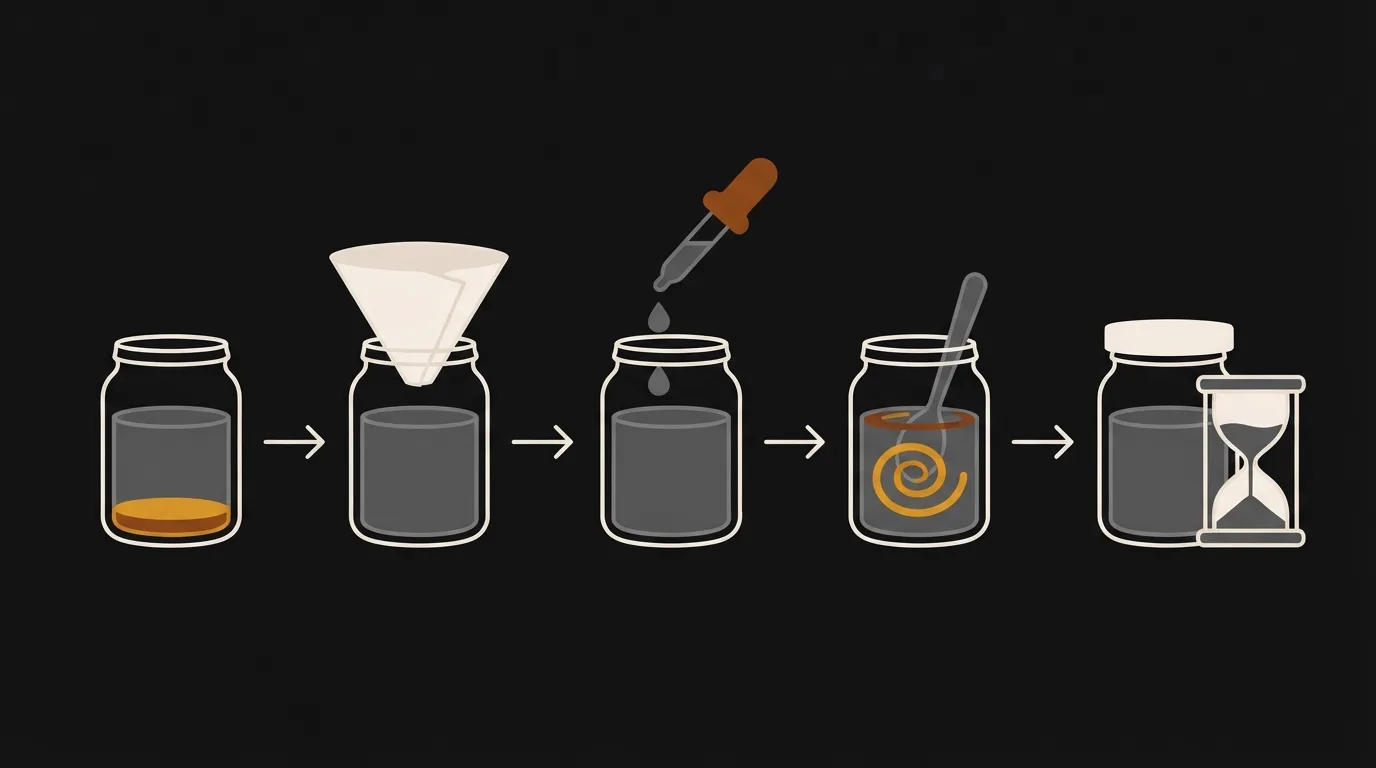
The EPA's sequence for bleach runs like this:
- Let cloudy water settle, then pour the top off through a clean cloth, a paper towel or a coffee filter.
- Find a clean dropper and bleach that has sat at room temperature for less than a year.
- Add the dose for your volume and strength from the table below, doubled for murky or icy water.
- Stir and leave it for 30 minutes. The water should smell slightly of chlorine afterward.
- If there is no smell, add the same dose again and wait another 15 minutes.
Ready.gov adds the step people forget. If the water still has no chlorine smell after the second dose, throw it out and find another source. Water that swallows two doses without a trace of chlorine left is carrying enough organic matter to use the chlorine up, and drinking it is a gamble.
How much bleach per gallon of water
The EPA table gives two columns, because the bleach on store shelves now comes in two strengths. Most older guidance, Ready.gov's included, was written for the 5.25 to 6 percent kind and gives the dose as 1/8 teaspoon per gallon. The CDC's archived emergency page treats 1/8 teaspoon and 8 drops as the same amount.
| Water | 6% bleach | 8.25% bleach |
|---|---|---|
| 1 quart | 2 drops | 2 drops |
| 1 gallon | 8 drops | 6 drops |
| 2 gallons | 1/4 tsp | 1/8 tsp |
| 4 gallons | 1/3 tsp | 1/4 tsp |
| 8 gallons | 2/3 tsp | 1/2 tsp |
The EPA counts 2 gallons as 16 drops of 6 percent bleach or 12 drops of 8.25 percent, and gives the same amounts for a liter as for a quart. Every line assumes clear water. When the water is murky or near freezing the EPA says to use twice as much, so a gallon of murky creek water takes 16 drops of 6 percent bleach. Cold slows the chemistry down, which matters in a winter outage when the water comes from a rain barrel on the porch or a pond with ice at the edges.
Droppers differ, and a drop of bleach from a narrow tip is smaller than one from a wide one. For anything bigger than a gallon or two, I'd measure with a set of kitchen measuring spoons kept only for bleach, since the teaspoon lines in the table are easier to repeat than counting forty drops by lantern light.
Which bleach works, and which does not
The label decides it. The EPA asks for regular, unscented liquid chlorine bleach whose label says it is suitable for disinfection and sanitization, with 6 or 8.25 percent sodium hypochlorite as the active ingredient. Both agencies rule out scented bleach, color-safe bleach and bleach with added cleaners. Ready.gov goes further and says the sodium hypochlorite should be the only active ingredient.
That rules out a surprising share of the bottles in a typical laundry room: the lemon and lavender jugs, the color-safe kind, and the ones sold as bleach plus a cleaner. If the label does not say regular, unscented and give the sodium hypochlorite percentage, leave it for the laundry. Buy one plain jug for the water kit and keep it apart from the laundry supply so nobody grabs the wrong one in the dark.
Strength matters for the count. Most of the "concentrated" jugs sold today are 8.25 percent, which is why the EPA's gallon dose for them is 6 drops. Someone following an old pamphlet's 1/8 teaspoon with concentrated bleach will slightly overdose, which mostly costs taste. Someone using a weak, old bottle at the 8.25 percent count will underdose, and that is the dangerous direction.
Bleach goes weak on the shelf
Sodium hypochlorite breaks down over time into salt and water. Heat and light speed it up. The EPA's instruction is specific: use fresh bleach, or bleach stored at room temperature for less than a year. A jug that spent two summers in a hot garage may hold far less chlorine than its label promises, and nothing about its look or smell will tell you so.
Chemical suppliers put rough numbers on it. Alliance Chemical, which sells sodium hypochlorite, writes that an unopened bottle holds its strength for about six months at 50 to 70°F and then loses roughly 20 percent a year, and that stronger formulas break down faster than weaker ones. Take the figures as a supplier's estimate. The practical rule they point to matches the EPA's: write the purchase date on the cap, store the jug inside the house in a dark cupboard, and replace it every year.
This is the strongest argument for the smell test. Stale bleach is the most common way the dose goes wrong without anyone noticing, and a faint chlorine smell after 30 minutes is the one sign a household can check that enough chlorine went in to do the job.
Wait times and the smell test
Chlorine does not work on contact. It needs time in the water to get through the outer layers of bacteria and viruses, so the 30 minutes in the EPA and Ready.gov instructions are part of the dose. Pour a glass off after five minutes and you have drunk partly treated water.
At the end of the half hour, lift the lid and smell. A slight chlorine odor, like a public pool from across the room, tells you some chlorine was left over after it reacted with whatever was in the water. If you smell nothing, the EPA says to repeat the dose and wait another 15 minutes. For very cold or murky water I would give it longer than the minimum, since cold slows the reaction, though neither agency names a longer time.
If the taste is too strong afterward, the EPA suggests pouring the water back and forth between two clean containers and letting it stand a few hours. That is easier on the stomach than adding sugar or drink mix, which some people reach for and which feeds anything the chlorine missed once the container is opened again and again.
What bleach will not do
Chlorine kills most germs, and that "most" matters. The CDC's archived emergency disinfection page says bleach kills some, but not all, disease-causing organisms, and names Cryptosporidium as one that chlorine and iodine may not control. Crypto is a parasite carried in animal and human waste, which is why it turns up in water from pastures, flooded barnyards and creeks below septic fields.
The fix is a second step. A rolling boil kills Crypto, and a filter with an absolute pore size of 1 micron or less strains it out. Running water through such a filter and then dosing it with bleach covers both gaps, because the filter catches the parasites and the chlorine kills the viruses most filters let through. Our guide to emergency water filters and what gets through them covers that setup in detail.
Bleach also does nothing for chemicals. Both the EPA and Ready.gov say plainly that boiling and chlorination leave heavy metals, salts and most other chemicals in the water. Floodwater with a fuel sheen, runoff from sprayed fields and brackish water near the coast stay unsafe however much chlorine goes in. Ready.gov's answer for that water is distillation, and the EPA's is to skip water with floating material, a dark color or a bad odor and look for a better source.
Mistakes that leave water unsafe
The same handful of slips turn up again and again in emergency guidance, and none of them is obvious in the moment.
- Using the wrong bottle. Scented, color-safe, gel or "with cleaner" bleach is ruled out by both agencies.
- Trusting an old jug. Bleach bought two winters ago, or kept somewhere hot, may be too weak to reach the dose.
- Dosing dirty water. Silt and leaves soak up chlorine before it reaches the germs, so settle and strain before the first drop goes in.
- Forgetting to double the dose for tea-colored creek water or a half-frozen rain barrel.
- Cutting the wait short, or drinking from the jug before the 30 minutes are up.
- Skipping the smell test, which is the only check that enough chlorine survived.
- Pouring treated water into a dirty container. A jug that held milk or garden chemicals undoes the treatment. Use clean, covered, food-grade containers.
- Treating every use but one. The EPA lists drinking, cooking, prepared drinks, washing dishes and brushing teeth. Ready.gov adds washing food and making ice. People remember the drinking water and forget the toothbrush.
- Counting on bleach for chemical water. Fuel, salt and farm runoff need a different source or a still.
One more belongs on the list for anyone storing water long term. City tap water is already chlorinated and does not need extra bleach before it goes into clean containers. Bleach is for sanitizing the containers themselves, at Ready.gov's rate of one teaspoon per quart of rinse water, and for treating water of unknown quality when the stored supply runs low. Our page on how much water to store per person covers the container side.
If you have no bleach
The EPA lists three fallbacks. Granular calcium hypochlorite, the "pool shock" sold as HTH, can be mixed into a stock solution: one heaping teaspoon in two gallons of water, then one part of that solution to 100 parts of water, about a pint per 12.5 gallons. It is a strong oxidizer, so the EPA asks for eye protection, a ventilated spot and the handling rules on its label. Tincture of iodine at 2 percent works at five drops per quart, ten for cloudy water, with a 30-minute wait. Disinfection tablets of chlorine, iodine or chlorine dioxide work at the strength their own label gives.
The two agencies part ways here. Ready.gov says iodine and camping or surplus-store treatments without sodium hypochlorite as the only active ingredient are not recommended. The EPA lists them as acceptable when liquid bleach is not on hand. My reading is that they belong as a backup in a go-bag or a car kit and the household supply should rest on plain bleach and a pot for boiling. Iodine also has the same Crypto gap the CDC names for chlorine.
My take: how I'd set up for bleach treatment
I'd keep one jug of plain unscented bleach with the water supply, never in the laundry, dated on the cap and replaced each fall. Beside it go a glass dropper, a 1/8 teaspoon measure, a stack of coffee filters, and a card with the EPA table taped inside the lid of the bin. That kit costs a few dollars and covers more gallons than any family will treat in a month.
For water that comes from a tap during a boil-water notice, bleach on its own is enough. For anything from a creek, pond or ditch, I would filter first and then chlorinate, because Crypto is the germ chlorine leaves behind and livestock water is where it lives. And for floodwater or anything that smells of fuel, I would not treat it at all if there were any other source within reach.
Treat one gallon from the garden hose this week, start to finish, smell test included. Doing it once in daylight is the best preparation for doing it in the dark. The rest of the water section covers storage, sources and filters.
