Water
55-Gallon Water Barrels
One drum holds two weeks of water for a family of four. Here is how to set it up so the water is still good when the taps stop.
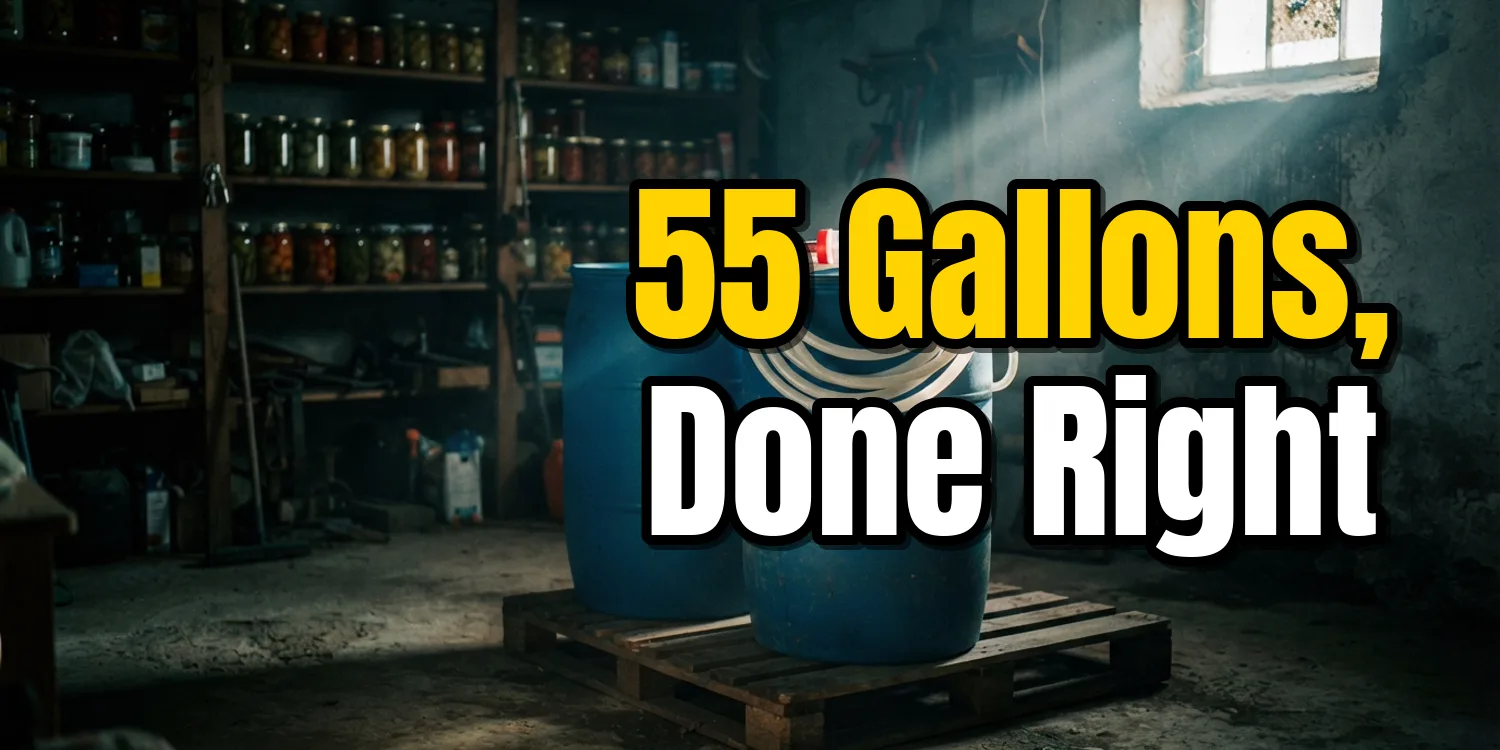
To store water long term in a 55-gallon barrel, use a food-grade plastic drum that has only ever held food or water, set it on a pallet in a cool, dark spot before you fill it, and fill it with chlorinated tap water through a hose made for drinking water. Swap the water every six months, which is the interval Ready.gov and the CDC give for water you store yourself, and treat it with bleach only if it came from a well or another unchlorinated source.
That covers it in two sentences. The rest of this page is the detail that decides whether the drum is a reserve you can drink from in a crisis or 450 pounds of stale water you cannot move: which drums are safe, what to buy with them, where they can sit, how to clean and fill them, the bleach arithmetic for a full drum, and a rotation routine that actually gets done.
Why a 55-gallon drum, and what it does not do
One gallon per person per day is the federal baseline, so a single drum is 55 person-days of water. For a family of four that is two weeks at the minimum, the same target our guide to how much water to store per person works out in full. Getting the same volume into 5-gallon jugs takes eleven of them, eleven caps to check and eleven dates to track. The drum puts it all on a footprint about two feet across.
The price of that density is that the water cannot travel. A full drum weighs over 450 pounds by University of Nebraska Extension's figure, so it is filled where it will stay and emptied with a pump. If you might have to leave the house, the drum stays behind. Most households that rely on drums also keep a few jugs or cases of bottled water for the car and for daily carrying.
What makes a food grade water barrel
A food-grade barrel is made of a plastic approved for contact with food and drinking water, almost always high-density polyethylene. Look for the recycling triangle with a 2 in it, or the letters HDPE, molded into the bottom or the side. New water drums are usually blue, with a closed top and two threaded bung openings about 2 inches across, one for filling and one to let air in while you pump.
The color is a convention more than a safety feature. Blue tells everyone in the house that the drum holds drinking water and not fuel or rainwater, and the opaque plastic keeps out the light algae need. A drum that lets light through will grow a green film along its walls within a season if it sits anywhere bright.
Used drums are where people get into trouble. Food plants ship syrups, juice concentrate and flavorings in the same blue HDPE drums, and those drums are resold. A drum that held a food product can be cleaned for water, though sugars and flavors take serious scrubbing, and some never lose the smell. Utah State University Extension warns off reused juice and milk containers for the same reason: food proteins are hard to remove. A drum that held anything else, including soap, cleaning chemicals, pesticide or an unknown liquid, is out for good. Plastic absorbs what it held, and no amount of rinsing makes it a drinking-water container. If the seller cannot tell you what was in it, treat it as a rain barrel and nothing more.
The small gear that goes with every drum
A drum on its own is hard to fill well and harder to empty. Four inexpensive pieces of kit make it workable:
- A bung wrench. The caps on a water drum are threaded plugs tightened past what fingers can turn. The wrench fits the slots on top and lets you open and close them without stripping the plastic.
- A drinking-water hose. USU Extension says filling a 55-gallon drum takes a specialty drinking-water hose. An ordinary garden hose is not made for drinking water and can carry plastic taste or worse into the drum. The white hoses sold for RVs and campers are the usual answer, labeled as safe for potable water.
- A siphon or drum pump. USU also lists a pump as part of the kit, because you will never tip a full drum. A hand pump that threads into the bung or a simple shaker siphon both work, and the pump should be kept clean and bagged between uses.
- A pallet or platform. Raising the drum off the floor matters for reasons covered in the next section, and the extra height gives you room to get a jug under the outlet hose.
Buy these with the drum and store them taped to it or hung on the wall above it. A bung wrench that lives in a toolbox in the garage is a wrench you will be hunting for by flashlight when the water main breaks.
Where a full drum can sit
Pick the spot before you fill anything, because once the drum is full it is not going anywhere. The CDC's storage conditions for emergency water are a temperature between 50 and 70°F, no direct sun, and distance from gasoline, pesticides and other chemicals. A basement slab or a ground-floor utility room usually meets all three. An attached garage often fails on two, with summer heat and the mower gas sitting on the next shelf.
Do not stand the drum directly on concrete or bare dirt. USU Extension says plastic on concrete or soil picks up odors that leave the water safe but change its taste, and a pallet or a few boards fixes that. Raising the drum also keeps it clear of a small basement flood and lets air move underneath.
Weight decides the rest. Four hundred and fifty pounds on a footprint of about two square feet is a heavy point load, and two drums side by side on one pallet is close to half a ton. A slab or a ground floor over a crawlspace on a solid joist run can take it. An upstairs closet over a long floor span is the wrong place, and a question for someone who can look at the framing.
Cold is the last check. Water expands by about 9 percent as it turns to ice, and a full drum in an unheated shed or outbuilding can split its seams or push out a bung during a hard freeze. If the only space you have gets below freezing, leave a few inches of headspace at the top and plan to move that water into the house in winter. Our guide to keeping stored water from freezing covers headspace, cold garages and thawing in detail.
Cleaning a drum before its first fill
A new drum from a water-storage supplier is clean enough to rinse and fill. A used food drum, or any drum that has been sitting empty, needs washing and sanitizing first. The CDC's method for water containers scales up without changes:
- Wash the inside with a few gallons of warm water and dish soap. Roll the drum on its side and slosh it so the soapy water reaches the walls and the underside of the top.
- Rinse until no suds or smell remain. Food drums may take several rinses.
- Mix the CDC's sanitizing solution: 1 teaspoon of unscented household bleach per quart of water. A gallon of it, 4 teaspoons of bleach in 4 quarts of water, is enough to wet the inside of a drum.
- Cap the drum and roll and tip it so the solution touches every inside surface, including the threads of both bung openings.
- Wait at least 30 seconds, drain it and let the drum air-dry upside down if you can.
Sanitize the caps and the pump tube the same way. They touch the water as much as the walls do and are the parts people forget.
Filling it: tap water, a clean hose and a label
Move the empty drum onto its pallet first. Then run the drinking-water hose for a minute to flush water that has been sitting in it, put the end into one bung and fill. Leave the second bung open so air can escape.
Fill to within an inch or two of the top in a heated space. In a space that could freeze, stop a few inches lower. Screw both bungs in firmly with the wrench, then mark the drum with a paint pen or a piece of tape: "drinking water", the fill date and whether you treated it. The CDC asks for the words and the date on every container of stored water so nobody mistakes it for something else and so you can see what is due.
A drum takes a while to fill from a household tap, so this is a good moment to do two drums at once with a splitter, or to fill one and clean the next.
Treating barrel water: when bleach is needed
Water from a city system is already disinfected. USU Extension says you do not need to treat tap water before storage, because municipal water arrives with its own sanitation treatment. Most people filling drums from a city tap can skip bleach entirely.
Well water, spring water and anything else that has not been chlorinated should be treated before it goes into storage. The dose is the same EPA rate used for treating water in an emergency: for clear water, 8 drops (about 1/8 teaspoon) of 6 percent unscented bleach per gallon. Across a full drum that comes to roughly 7 teaspoons, a little over 2 tablespoons. With 8.25 percent concentrated bleach the EPA rate is 6 drops a gallon, close to 1 3/4 tablespoons for the drum. Our page on purifying water with bleach has the full drop table, which bleach to buy and why an old bottle fails.
Add the bleach to the empty drum, then fill, so the incoming water mixes it. After 30 minutes the water should carry a faint chlorine smell. If your well water is cloudy, settle or filter it first, because bleach does a poor job on murky water and the EPA doubles the dose for it.
Bottled water preservers are sold as an alternative, and The Ready Store, a preparedness retailer, says one bottle treating 50 to 55 gallons extends the water's life from 12 months to 5 years. That is a seller's claim about its own product line. Federal guidance does not stretch the six-month rotation for any additive, and the same retailer still tells buyers to check treated water every 6 to 12 months.
How often to rotate stored water
Rotate a drum you filled yourself every six months. That is the figure Ready.gov and the CDC give for self-stored water, and the one USU Extension repeats. USU's Teresa Hunsaker adds that properly disinfected water stored in ideal conditions should keep indefinitely, and that the six-month change is about keeping the best quality and avoiding a stale taste.
That distinction matters for how you read your own drum. Water does not turn dangerous on a date. What happens over months is that chlorine fades, any germ that got in through a dirty pump or a loose cap has time to multiply, and the water goes flat. Six months keeps all of that small. Stretching it is a judgment about your own setup, and it depends on how clean the drum and fill were.
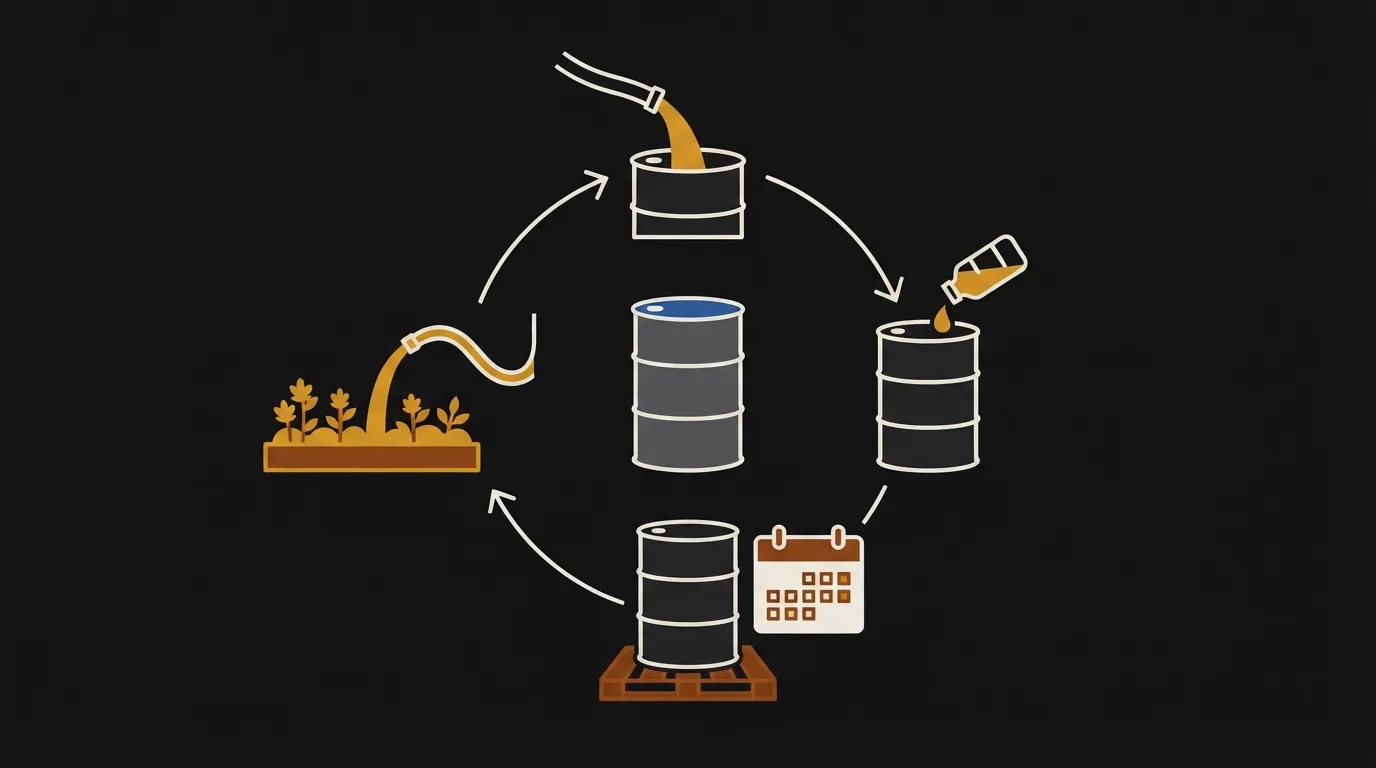
When the date comes up, open a bung and look and smell before you dump anything. The Ready Store lists the signs that water has turned: a build-up around the edges, algae, cloudiness, bacterial growth and a foul smell. Any of those means the drum has to be washed and sanitized before you refill it, and you need to find out how the problem got in. It is usually light getting in, a pump that was stored dirty or a cap that never sealed.
The rotation itself is an afternoon job. Pump the drum down onto the garden, a lawn or into the washing machine. Rinse it with a few gallons of fresh water, sanitize it if anything looked or smelled off, then refill and re-date it. Tie the job to something that already happens twice a year, such as the clock changes in spring and fall, and do one drum each weekend if you have several so the house is never empty of water.
Drawing water from a drum in an emergency
Pump into clean, food-grade jugs and carry those to the kitchen, rather than running a hose across the house each time someone wants a glass. Keep the pump end clean and off the floor between uses, and close the bung after each draw so dust and insects stay out.
Water that has been sealed for months often tastes flat. USU Extension's fix is to pour it back and forth between two clean containers several times, which puts air back into it. If the drum's history is doubtful, it was filled from an unknown source or the date is long past, treat each jug with bleach at the clear-water rate or bring it to a rolling boil before drinking. A filter can take out taste and sediment, and our guide to what emergency water filters remove explains which ones also stop bacteria.
Use the drum for drinking and cooking first and find other water for flushing and washing: the bathtub you filled before the storm, a rain barrel, a pool. A drum shared between drinking and toilets runs out in days.
How many drums a household needs
Count people and days, then divide by 55. Four people for two weeks is one drum. The same four people for a month is a little over two drums, and a summer outage where Ready.gov says needs can double takes four. A household of six planning for a month needs three to four drums at the baseline before heat or pets.
The food and water storage calculator does that arithmetic for your family and gives the weight, which is the number that tells you how many drums your floor and your floor plan can actually hold.
My take
If you are starting out, I'd buy new drums from a water-storage supplier rather than used food drums. The saving on a used drum is small, and the cleaning is a long job with no guarantee the syrup smell ever leaves. I'd fill from the city tap with no additive, date the drum, and put a recurring reminder for the six-month change on the phone the same day.
For a family of four I'd stop at two drums in the basement and spend the next money on a filter and fresh bleach, because those turn rainwater and creek water into a supply that does not end when the drums do. A third or fourth drum is worth it where the house is on a well with no backup power, since a well pump without electricity leaves stored water as the only supply.
The rest of our guides on storing, finding and treating water are in the water section.
Sources
- Utah State University Extension: Water storage tips
- Ready.gov: Water
- Ohio State University Food Safety: Creating and storing an emergency water supply (CDC guidance)
- University of Nebraska Extension G2220: Rainwater harvesting with rain barrels
- EPA: Emergency disinfection of drinking water
- The Ready Store: Rotating your water storage
