Water
Keeping Stored Water From Freezing
A winter outage can freeze the water you stored for it. Here is where to keep it, how full to fill it and what to do when the house goes cold.
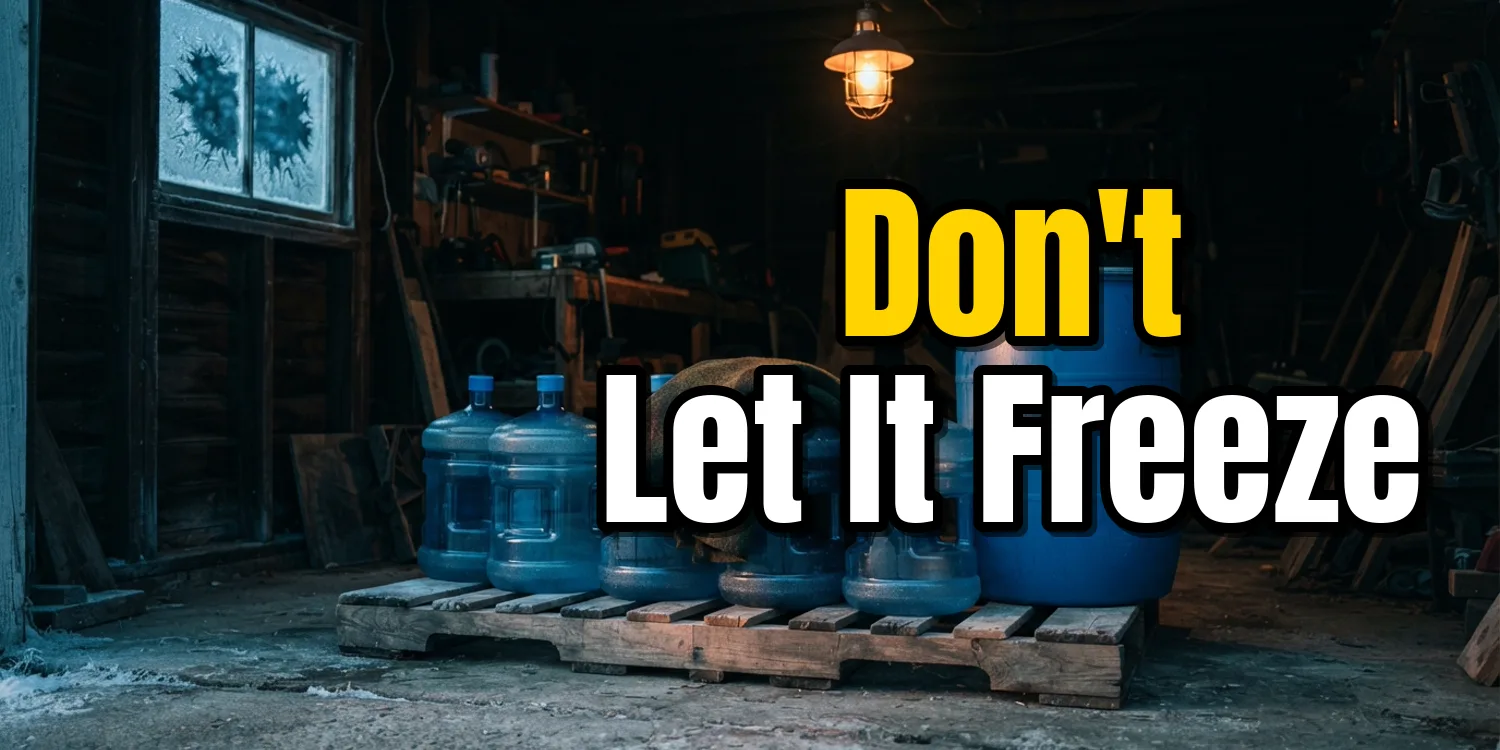
The surest way to keep stored water from freezing is to keep it inside the heated part of the house, in food-grade plastic, with a little empty space at the top of every container. Anything that has to sit somewhere colder, an unheated garage, a shed or a crawlspace, should be filled to about 90 percent so the ice has room to grow, kept off the slab, and moved indoors before a long outage takes the heat with it.
Water expands by about 9 percent as it turns to ice, and that is what splits jugs, pops bungs and bursts pipes. The rest of this page takes it in order: which containers survive a freeze, where water can live in a cold house, what changes when the power goes out in January, how to thaw ice without wrecking the container or the water, and what to do about the pipes.
Why winter is hard on stored water
Most water storage advice is written for heat. The CDC's guidance puts stored water between 50 and 70°F, out of the sun and away from chemicals, and the usual worry is a hot garage cooking plastic in August. Winter brings the opposite problem, and it tends to arrive at the worst moment. Ready.gov warns that a winter storm can last several days and cut off heat, power and communication services together. The same storm that makes your stored water necessary can also freeze it.
Cold threatens stored water in two ways. Ice needs more room than the water it came from, and a container filled to the brim has nowhere to put it. The American Red Cross puts it bluntly for pipes, saying that no matter how strong a container is, expanding water can break it. Even an undamaged container can lock its water away: a drum frozen solid cannot be poured, and a large block of ice takes days to melt in an unheated room.
Will frozen water barrels crack?
They can, and the risk depends on how full the drum is and what kind of plastic it is. A blue HDPE water drum has some give in its walls, so a drum with a few inches of air at the top usually bulges as it freezes and settles back when it thaws. A drum filled to the threads has no air to compress, so the ice pushes on the walls, the seams and the two bung caps. Those caps and any spigot fitting are the weak points. A popped bung leaves the water open to dust and whatever else is in the room, and a split seam drains the drum on the floor the day it thaws.
Rain barrels show what happens when nobody plans for it. Gardening writers who cover rain catchment warn that a barrel left full through winter can crack its sides and be ruined for good, which is why rain barrels get drained in fall.
For a drinking-water drum the fix is headspace. With water growing about 9 percent as it freezes, a drum that might freeze should be filled to roughly 90 percent, leaving 5 or 6 gallons of air in a 55-gallon drum. That gives the ice room to expand upward into the empty space. A drum that lives in a heated basement all year can be filled to within an inch or two of the top, as our guide to filling, treating and rotating 55-gallon water barrels describes.
Which containers survive a freeze, and which do not
Material matters as much as how full the container is. Here is how the common choices behave in the cold, from the most forgiving to the least:
- HDPE jugs and drums, the opaque plastic marked with a 2 in the recycling triangle. They flex, and with headspace they usually come through a freeze intact. This is what most water storage is made of for good reason.
- Factory-sealed bottled water in thin PET bottles. Cases of it often bulge and sometimes split a seam or crack a cap when they freeze. A case that froze is worth inspecting bottle by bottle before you count it.
- Stackable rigid bricks and jugs with built-in spigots. The spigot and its gasket take the strain first, and a cracked tap leaks slowly enough that you may not notice until the shelf is wet.
- Glass jars and bottles. Glass does not stretch, so a full jar can crack in a freeze, and a jar taken from a cold room into hot water can crack from the sudden change. Keep glass inside the heated house or leave it out of your water storage.
Whatever the container, the same habit protects it: a gap at the top in anything that might see frost, and caps checked after every hard cold spell.
Storing water in an unheated garage
An attached garage is where a lot of water ends up, because it has the floor space and the house does not. In most of the country it is a poor place for drinking water in winter, and a poor one in summer too. An attached garage usually stays a few degrees warmer than outside because the house wall leaks heat into it, but in a hard cold snap it will drop below freezing, and a detached garage or shed tracks the outdoor temperature closely.
If the garage is the only space you have, set it up for the cold:
- Hang a min/max thermometer near the water. It records the lowest temperature since you last reset it, which tells you after one cold night whether that corner freezes.
- Fill every container there to about 90 percent and stand it on a pallet or boards, off the slab. Concrete pulls heat out of whatever sits on it, and USU Extension also notes that plastic on concrete picks up odors.
- Push the water against the wall the garage shares with the house, which is the warmest wall it has. Keep it away from the big door, which lets in the most cold.
- Cover the group with old blankets or rigid foam board. Insulation only slows cooling, because the water makes no heat of its own, but a slower drop can carry a stack of jugs through one cold night.
- Keep the garage door closed in cold weather. The Red Cross gives the same advice for any water lines that run through a garage.
I would treat the garage as overflow and judge it by that thermometer: if it read below 32°F once, nothing you plan to drink in the first week belongs there. Keep the water for those first days inside the living space, and use the garage supply for washing, flushing and refilling the indoor jugs once the weather turns.
Where water stays liquid indoors
The heated part of the house is the place for water you will need first. Interior closets, the space under beds, a pantry and the bottom of a coat closet all hold cases of water or a few 5-gallon jugs without taking over a room. In a basement, the warmest spot is usually near the furnace and along interior walls, and the coldest is against the foundation wall where the water line comes in.
Spread the supply rather than putting it all in one corner. If a pipe bursts in the basement or the far bedroom gets too cold, water stored in two or three places means one problem does not take all of it. Our guide to how much water to store per person has the totals and the weight limits for each spot.
Keep water from freezing in an outage
When the power goes out in winter, a house cools room by room, and the water you stored in the back bedroom or the basement starts losing heat with it. A few moves keep it usable:
- Bring the first days of water into the warm room. Most families in a long outage heat one room and close off the rest, as our guide to heating a house without power explains. Carry enough jugs for three or four days into that room on the first afternoon, before the rest of the house drops below freezing.
- Use a cooler as an ice chest in reverse. A large picnic cooler keeps cold out as well as it keeps cold in. Jugs of water packed into a cooler in an unheated bedroom stay liquid far longer than the same jugs on an open shelf.
- Pack the big containers together. A cluster of full jugs loses heat more slowly than the same jugs spread across a floor, and a full drum holds its warmth longer than any jug. Leave the drums where they are and let them be the last water to freeze.
- Fill containers from the tap before the cold sets in. If the outage looks long and the plumbing may have to be drained, fill pitchers, pots and clean jugs first, and fill the bathtub for flushing. On city water the pressure often holds for a while after the power fails. On a well, the pump stops with the power, so whatever is in the pressure tank and the pipes is all you get until power returns.
Do not heat water containers with anything that has a flame or glows red. A plastic jug against a kerosene heater or a wood stove can melt, and a heater that gets bumped over is a fire.
Thawing frozen water safely
Freezing does not clean water and does not contaminate it. Water that went into a sealed, food-grade container clean is the same water after it thaws, so the question is whether the container survived. Look at every frozen container before you trust it:
- A cap pushed up, a crack along a seam or a bulge that did not settle means the seal broke. Treat that water as if it came from an unknown source: boil it, or chlorinate it at the rate in our guide to purifying water with bleach, before drinking it.
- A container that is whole and still sealed needs nothing more than thawing.
Thaw slowly. Bring jugs into the warm room and let them sit. If you need water sooner, pour off the liquid that thaws first, or set a jug in a basin of lukewarm water. Do not put a plastic jug on the stove or near a fire, and do not pour boiling water over a frozen glass jar, which can shatter from the sudden heat. For a drum frozen solid, the practical answer is time and a warmer room. Pump off the liquid as it forms and leave the core to melt.
Melting snow is a fallback for washing and flushing, and it takes more fuel than most people expect. If you intend to drink melted snow, boil it or run it through a filter that stops bacteria first. Our page on what emergency water filters remove explains which ones do.
Taps, pipes and the tank
The water in your pipes and hot water tank is stored water too, and a freeze can cost you both that water and the plumbing. The steps for keeping pipes from freezing, dripping taps, opening cabinets and when to drain the system, are in the pipes section of our guide to heating a house without power. What follows is the part that touches your water supply.
Do the outside first, before the cold arrives. The Red Cross says to disconnect and drain garden hoses, close the inside valves that feed outdoor hose bibs, then open the outside bibs so any water left in them can expand without breaking the pipe. A hose left on a bib holds water against the valve, and that is the first fitting to split.
Insulation helps less than people hope once the power stays off for days. Utah State University Extension points out that pipe insulation will not protect a line through prolonged freezing unless there is some heat or some water flow, so foam sleeves buy time and are not a plan for a week without power. USU also says dripping taps works but wastes water, and that people rarely leave the hot side running, so hot lines freeze too.
If the house is going to freeze, draining the plumbing protects it, and the water that comes out is clean drinking water from your own system. Shut the main valve, then catch the water as you open the taps, starting at the highest ones and finishing at the lowest. A typical tank water heater holds 40 or 50 gallons. Turn its gas or power off before you drain it or draw from it, open a hot tap upstairs to let air in, and fill clean containers from the drain valve at the bottom. The first gallon may carry sediment, which settles out if you let it stand.
When a pipe does freeze, USU's advice is to shut off the main supply first, open the faucet on that line and start thawing at the faucet end, warming the pipe gradually with a hair dryer, a heating pad or towels soaked in hot water. Never use an open flame. If the line may leak as it thaws, keep buckets under it and open other faucets to drain the system. A freeze in a hot line or the main often means turning the water heater off as well.
A fall checklist for water storage
Do this once a year, before the first hard freeze, and tie it to a date you already keep, such as the fall clock change:
- Walk every place you keep water and note which ones are outside the heated envelope.
- Pour a little out of each container in a cold spot so it sits at about 90 percent full.
- Move glass, and enough water for the first three days, into the heated living space.
- Drain and disconnect garden hoses, close the inside valves for hose bibs, and drain the rain barrel.
- Find the main water shutoff and the water heater's drain valve, and show everyone in the house where they are.
- Set out a min/max thermometer in the garage or shed, and read it after the first cold night.
- Put a hose, a bucket and a clean jug next to the water heater so draining it in the dark is one job, not a search.
My take
I'd start with three days of water for everyone in an interior closet of the heated house, whatever else you store elsewhere. It is the water you can reach on the first night of an outage, and it is the last to freeze. Everything else can live in the basement or, failing that, the garage, filled to 90 percent and raised off the slab.
I'd also learn the drain-down before winter rather than during it. Knowing where the main shutoff is and having containers ready beside the tank turns a frozen house from a plumbing disaster into an extra 40 or 50 gallons of clean water. For the rest of the water plan, storing it, finding it and making it safe, see the water section.
Sources
- American Red Cross: Preventing and thawing frozen pipes
- Utah State University Extension: Advice to prevent frozen pipes
- Ready.gov: Winter weather
- Ohio State University Food Safety: Creating and storing an emergency water supply (CDC guidance)
- Utah State University Extension: Water storage tips
- Building Moxie: Winterizing a rain barrel
