Food storage
How to Pack Rice, Beans and Wheat to Last 30 Years
Dry staples sealed away from oxygen, moisture and heat keep for decades. The method takes an afternoon and costs little more than the food.
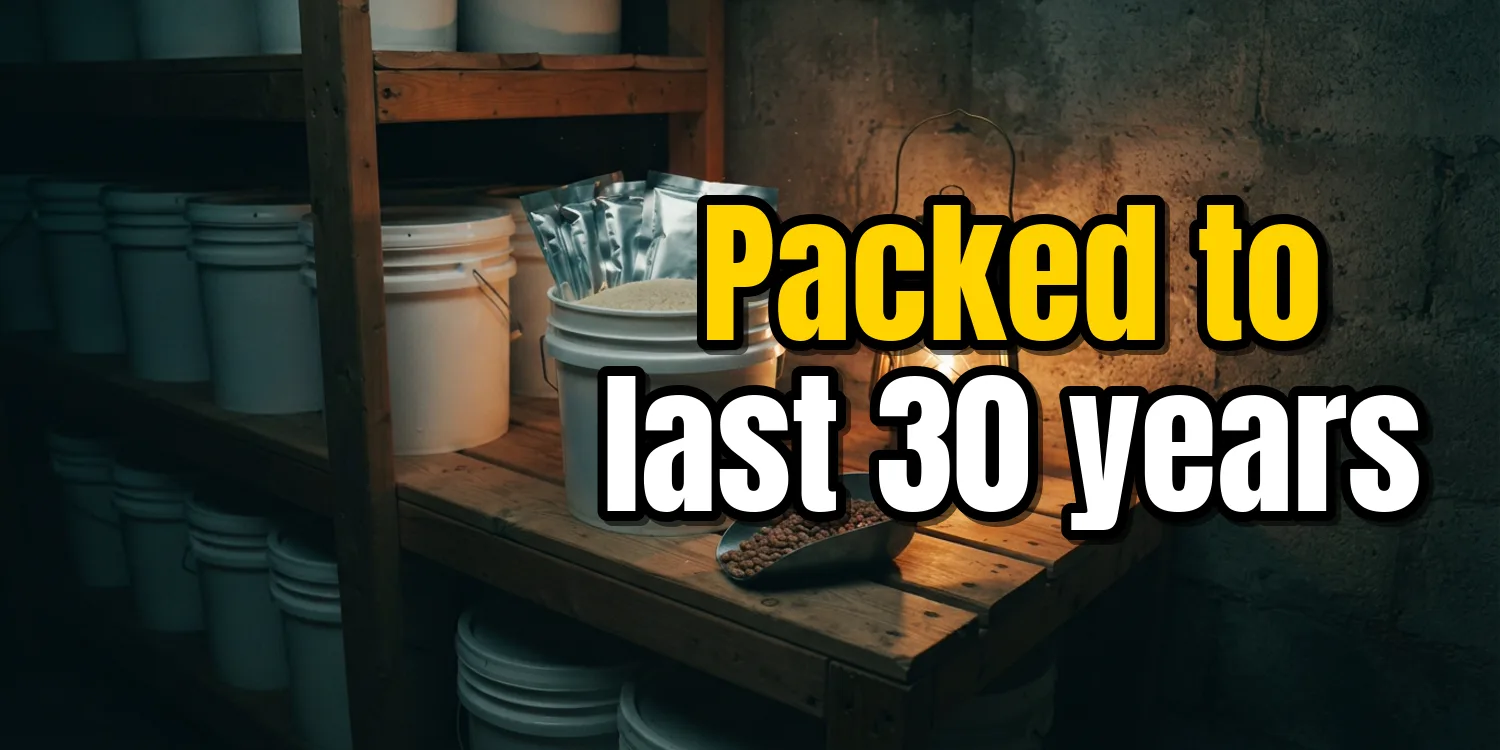
White rice, hard wheat and dry beans can stay edible for 30 years if they go into an airtight container with an oxygen absorber and then live somewhere cool, dark and dry. Food scientists at Brigham Young University taste-tested stored food and found wheat and white rice very acceptable after 30-plus years, with beans, oats and potato flakes holding up to 30. Packing a bucket takes about an hour once you have the supplies. Where you keep the buckets afterward decides whether you get those decades or a fraction of them.
This guide walks through what to store, which containers hold up, how oxygen absorbers work, the exact packing steps, and the two mistakes that ruin a batch: moisture and heat.
Why dry staples last when other food does not
Stored food is attacked by four things: heat, moisture, oxygen and light. Take those away and very little is left to break the food down. Utah State University Extension spells out the targets in its food storage guidance. Dry goods for long-term storage should hold 10 percent moisture or less. The best storage temperature is a steady 40 to 60 degrees Fahrenheit. And the container should be hermetically sealed, with the oxygen removed.
Grains and legumes start out close to that standard. Store-bought rice, hard red or white wheat, and dry beans are already dried down far enough to store when you buy them. That is why they form the backbone of nearly every long-term food plan, while canned goods, which carry water and acid, have much shorter lives and need rotating.
Oxygen is the part most people underestimate. Air is roughly 78 percent nitrogen and 21 percent oxygen. An oxygen absorber takes out the oxygen and leaves what USU describes as about 99 percent pure nitrogen in a partial vacuum. Without oxygen, the fats in food oxidize far more slowly, and insect eggs hidden in the grain cannot hatch into a living infestation.
What to pack, and what to keep out
The foods that store for decades share one trait: they are dry and low in fat. BYU's research team lists wheat and white rice as the longest keepers, followed by dry beans, rolled oats, macaroni, dried apples and potato flakes. Nonfat dry milk lasted up to about 20 years in their tests. The same team says some commodities, such as cooking oil and dried eggs, should be used within a couple of years.
Here is how the common staples sort out:
- Pack for the long haul: white rice, hard wheat berries, dry beans and lentils, rolled oats, plain pasta, dehydrated potato flakes, nonfat dry milk.
- Pack, but expect shorter lives: white flour, cornmeal and other ground grains. Grinding exposes more surface to oxygen, so whole wheat and whole corn keep far longer than their flour.
- Keep in the rotating pantry instead: brown rice, whole-grain flour, nuts, granola and anything with noticeable oil. The oil goes rancid, and an absorber only slows it.
- Store without absorbers: sugar, salt and baking soda. They keep indefinitely dry, and an absorber tends to set sugar into one hard lump.
A word about beans. Old beans stay safe and keep their calories, but they harden with age and can take far longer to soften in the pot. That costs water and fuel, both of which will be scarce in the situations you are storing for. Pinto, black and navy beans all store well. Plan on rotating some of them through regular meals so the oldest stock is never decades older than it needs to be.
Containers that hold up
USU Extension lists the containers that seal well enough for long-term dry storage: #10 cans, sealable food-grade buckets, food-grade lined metal or plastic drums, foil pouches (the Mylar bags preppers use), and PETE bottles, the clear plastic used for soda and juice, for dry products like wheat, corn and beans.
For most households, the practical system is a Mylar bag inside a five-gallon food-grade bucket. Each part covers the other's weakness. The bag is the real barrier against oxygen and moisture, because a plastic bucket lets a small amount of air through its walls over the years. The bucket protects the bag from punctures, mice and light, and gives you something square to stack. A bucket alone is fine for food you will eat within a few years. Add the bag when you are packing for decades.
A few points about buying them:
- Buckets: look for food-grade HDPE, usually marked with the number 2 recycling symbol, with a gasketed lid. A gamma lid, the kind that screws into a ring, makes the bucket you are eating from much easier to open and close.
- Mylar bags: thicker bags resist the sharp ends of wheat kernels and pasta. One-gallon bags are worth having alongside the five-gallon size, because a small bag can be opened and used up without exposing your whole supply.
- PETE bottles: clean, dry two-liter soda bottles with a good cap and one small absorber are a cheap way to store rice and wheat in kitchen-sized portions.
How oxygen absorbers work, and how many to use
Each absorber is a small packet of iron powder. When it meets the oxygen in the air, the iron rusts and binds that oxygen. The packet warms slightly as it works, and the bag pulls in tight around the food once the oxygen is gone, usually within a day or two.
Absorbers are rated in cubic centimeters (cc), the amount of oxygen each can take up. How many you need depends on the size of the container and how much air is left between the pieces of food. Dense, fine food like rice or flour leaves little air. Large, irregular food like beans or pasta leaves more and needs a bigger allowance. Follow the absorber maker's chart for your bag size and food. Most suppliers put a five-gallon bag at around 2,000 cc, and adding a little extra does no harm, while too little leaves oxygen behind.
Absorbers start working the moment they hit open air. That is the step that ruins the most batches:
- Fill and stage every bag before you open the absorber pack.
- Take out only the absorbers you will use in the next 15 to 20 minutes, and reseal the rest in a small jar or a clamped bag right away.
- A fresh absorber feels soft and powdery. One that has gone hard and lumpy is spent and should be thrown out.
Packing a bucket, step by step
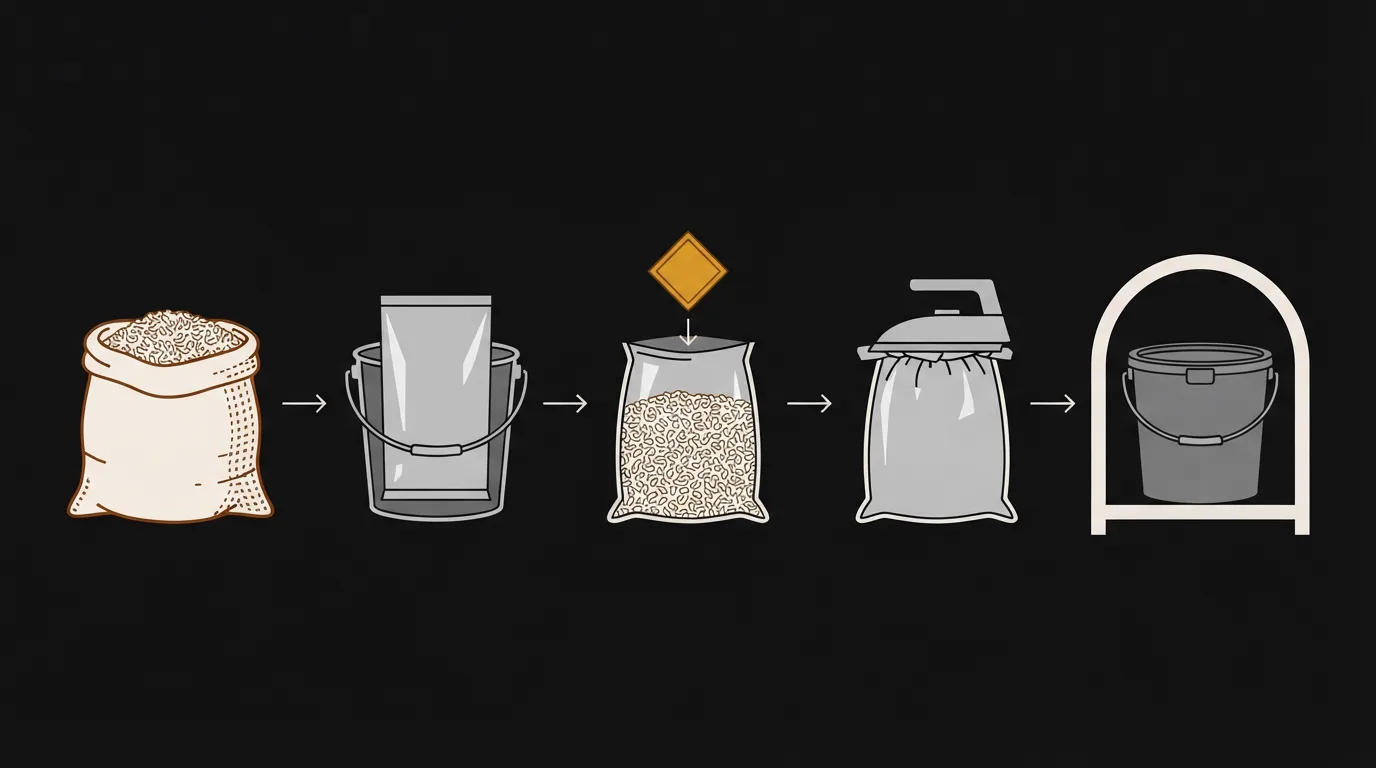
- Set up a clean, dry work area. Do this on a dry day, not in a humid basement during a rainy week. Lay out the buckets, bags, a scoop, a funnel, a clothes iron or impulse sealer, a flat board to iron against, and a marker.
- Line each bucket with its bag. Open the Mylar bag fully and fold the top edge over the rim of the bucket so it stays open while you fill it.
- Fill and settle. Pour in the rice, wheat or beans, shaking or tapping the bucket every few inches so the food settles and less air is left between the grains. Stop a few inches below the top so the bag will close easily.
- Fill all the buckets before you touch the absorbers. This is what keeps the absorbers from wasting themselves on room air.
- Add absorbers and press out air. Drop the absorber in on top of the food. Gather the bag, push out as much air as you can with your hands, and lay the top edge flat across the board.
- Seal. Run a hot clothes iron, set to high with no steam, slowly across the top of the bag. Make two seals a little apart for safety. Leave the last inch open at one corner, squeeze out the remaining air, then seal that corner too.
- Label. Write the food, the date and the absorber size on the bag and the bucket lid. Five years from now you will not remember what is in the third bucket from the left.
- Lid on, and wait. Press the lid down with a rubber mallet. Check the bags after two days. A bag that has pulled tight like a brick has a working seal. A bag that is still loose needs a fresh absorber and a new seal.
The dry-food rule, and why it matters
This method is only for dry food. USU Extension warns that botulism poisoning may result if moist products are stored in packaging that reduces oxygen. The bacteria behind botulism thrive in exactly the low-oxygen conditions an absorber creates, so anything with real moisture in it does not go into a sealed Mylar bag. Moist food that you want on a shelf gets canned by a tested process, and our guide to old canning methods that are no longer safe covers the shortcuts to avoid.
That rules out home-dried food that is still leathery or flexible, fresh baked goods, brown sugar, and anything you are not sure has been dried down to about 10 percent moisture. Commercial white rice, wheat, beans and pasta are already there. Home-dehydrated vegetables are safe to pack only when they are brittle and snap cleanly. If they bend, they go in the freezer or the pantry, not the bucket.
Humid air on packing day undoes careful drying. Grain will absorb moisture from damp air, which is why the work belongs on a dry day, indoors, in a room that is not steamy from cooking.
Dealing with insects before they deal with you
Weevils and pantry moth eggs ride in on grain from the store. In a sealed bag with a working absorber, they cannot develop. If you buy grain in bulk paper sacks and plan to store it in buckets without Mylar, kill the eggs first.
USU's method is simple: put the food in a deep freezer at 0 degrees for three to four days, which kills live insects, larvae and eggs. Then let the bags come back to room temperature before you open them, so condensation does not form on cold grain. A chunk of dry ice in the bottom of a bucket displaces the air with carbon dioxide as it sublimates, and USU lists it alongside absorbers and nitrogen flushing as a way to drive out oxygen.
Where you keep it decides how long it lasts
Temperature is the factor BYU's researchers single out as most crucial. USU Extension cites USDA figures that shelf life is cut in half for roughly every 11 degrees of temperature rise. A bucket that would last decades at 60 degrees will last far less in an attic or a garage that reaches 100 degrees in July.
BYU's lead researcher put the practical answer memorably: if you ever have to eat your food storage, you will wish you had stored the food in the house and the furniture in the garage. Good spots inside a house:
- A basement wall away from the furnace and water heater
- Interior closets on the north side of the house
- Under beds, with buckets on their sides or bags in shallow totes
- A root cellar, if the buckets sit on boards off the damp floor
Keep buckets off bare concrete, which wicks moisture and cold into the plastic, and out of direct light. Avoid freezing temperatures too, which USU lists separately as something to keep away from stored food.
Storing it is half the job, so plan to cook it
A bucket of wheat is not bread. Whole wheat berries need a grain mill to become flour, and a hand-crank mill is the one that works when the power is out. Beans need hours of simmering, or an overnight soak and then a long cook, which means fuel and water. Rice needs about twice its volume in water.
That links your food store to everything else in a household plan. The water section covers how much to store for cooking as well as drinking, and the old ways section covers cooking on wood and keeping a fire going for long simmers. A household with fifty pounds of beans and no way to boil them for three hours has a storage problem disguised as a food supply.
Open your stored food now and then and cook it. You learn which recipes your family will actually eat, whether your mill works, and how long your old beans take. Ready.gov's food guidance makes the same point for short emergencies: choose foods your family will eat.
My take: where I would start
I would start with white rice and pinto beans, because they are cheap, they cook into a complete meal with a little salt and fat, and almost every family already eats them. One five-gallon bucket of each, packed with Mylar and absorbers, is a sensible first afternoon and teaches every step of the method. To size the whole store, our guide to how much food a family of four needs for three months works out the pounds and buckets.
After that I would add wheat only if someone in the house will bake with it, along with a hand mill. Rolled oats come next, for breakfasts that need little fuel. I would skip buying pre-packed buckets of mixed meals until the basics are in place, since you pay mostly for convenience and get food you have not tasted.
Above all, I would put the first buckets somewhere inside the living space before buying more. Fifty buckets in a hot garage are worth less than ten in a cool closet.
