Food storage
Three Months of Food for a Family of Four
The answer in pounds, buckets and meals, worked out from published calorie needs and long-standing food storage guidance.

A family of four eating normally burns through about 8,000 to 8,500 calories a day, which comes to roughly 750,000 calories over three months. In practice that means 300 to 480 pounds of grain, backed by beans, cooking oil, powdered milk, sugar and salt, or else 13 weeks of the meals your family already cooks, bought ahead and rotated.
Most families are best served by both: a shelf of the food you normally eat, and a smaller layer of sealed staples behind it. If you already know your numbers and want to start, pack your first bucket of rice or beans. The rest of this page shows how the numbers are reached, so you can adjust them for your own household.
Start with calories, because pounds follow from them
Every storage list you will find is a calorie budget in disguise. The Dietary Guidelines for Americans publish estimated daily needs by age, sex and activity, and the Merck Manual reprints that table in one readable chart. For adults aged 19 to 60, it puts men at 2,200 to 2,600 calories when sedentary and 2,600 to 3,000 when active. Women run 1,600 to 2,000 sedentary and 2,200 to 2,400 active. Children aged 7 to 18 span a wide band, from 1,200 calories for a sedentary girl up to 3,200 for an active teenage boy.
Take a typical household: a father in his forties, a mother in her forties, a 13-year-old son and a 9-year-old daughter. Taking both parents as moderately active and using the middle of each range gives something like this:
| Person | Per day | 90 days |
|---|---|---|
| Father | 2,600 | 234,000 |
| Mother | 2,000 | 180,000 |
| Son, 13 | 2,200 | 198,000 |
| Daughter, 9 | 1,600 | 144,000 |
| Household | 8,400 | 756,000 |
Lean toward the active column. The situations you store food for, a long outage, a winter with no heat, a job loss that turns you to the garden, involve hauling water, splitting wood and walking more. A household that budgets for a sedentary office week will run short when everyone is doing physical work.
The food storage calculator, in four lines
Online calculators ask for the number of adults and children and print a list. You can do the same arithmetic on the back of an envelope, and it is worth doing once by hand so you trust the result:
- Add up daily calories for everyone in the house from the table above. Use the active figure for anyone who will do heavy work.
- Multiply by 90 for three months. For our example family that is 756,000.
- Divide by about 1,600 to get the pounds of dry grain and beans that would supply all of it. USDA's FoodData Central lists raw long-grain white rice at 365 calories per 100 grams, which works out to about 1,650 calories a pound, and dry oats, wheat and beans land in the same neighborhood. For the example family, that gives roughly 470 pounds.
- Treat that as the ceiling. Oil carries more than twice the calories of grain per pound, and sugar, milk powder and canned meat each add their share, so a mixed store weighs less than an all-grain one.
There is a shortcut hidden in the arithmetic. A quarter of a year times four eaters is twelve person-months, which is exactly one year for one adult. Any reputable per-adult yearly list therefore doubles as a three-month list for a family of four, with a little margin built in because younger children eat less than an adult.
What 300 to 480 pounds of staples looks like
The University of Georgia Extension publishes a bare-bones bulk staples list per adult per year, based on FEMA and Church emergency preparedness materials. Because of the shortcut above, its amounts are also a three-month supply for four people:
| Staple | Amount |
|---|---|
| Wheat | 240 lb |
| Corn | 240 lb |
| Dry beans | 120 lb |
| Powdered milk | 75 lb |
| Fats and oil | 20 lb |
| Iodized salt | 5 lb |
| Vitamin C | 180 g |
UGA gives the beans as soybeans, though pinto, black or navy beans fill the same role for most families. Its note that a gallon of oil weighs about 7 pounds puts the fat at just under 3 gallons, and it says to rotate the vitamin C every two years.
That list is built to keep people alive, and nobody would want to live on that much wheat and corn. The Church's 1989 guidance in the Ensign magazine suggests a friendlier mix. Instead of a wheat-only store of 300 to 400 pounds per person a year, it proposes 200 pounds of wheat berries, 100 of flour, and 25 pounds each of rice, rolled oats, dried corn and macaroni. Scaled to our family for three months, that is still about 400 pounds, split six ways so meals do not all taste the same.
The bucket counts come from weights the Church publishes for its own storage pouches: a one-gallon pouch holds 7 pounds of wheat or 6.8 of rice, according to its long-term storage guide. A five-gallon bucket filled to an inch below the rim holds a little under 35 pounds of either. Plan on nine to fourteen buckets of grain for three months, depending on how much of your mix is grain.
Round out the staples with sugar or honey, baking soda, baking powder, yeast and some vinegar. UGA's supplementary list for one adult over a year includes 40 pounds of white sugar, a pound each of baking soda and baking powder, half a pound of dry yeast and half a gallon of vinegar. Those are the things that turn wheat and beans into bread, biscuits and pickles.
The faster route: 13 weeks of what you already eat
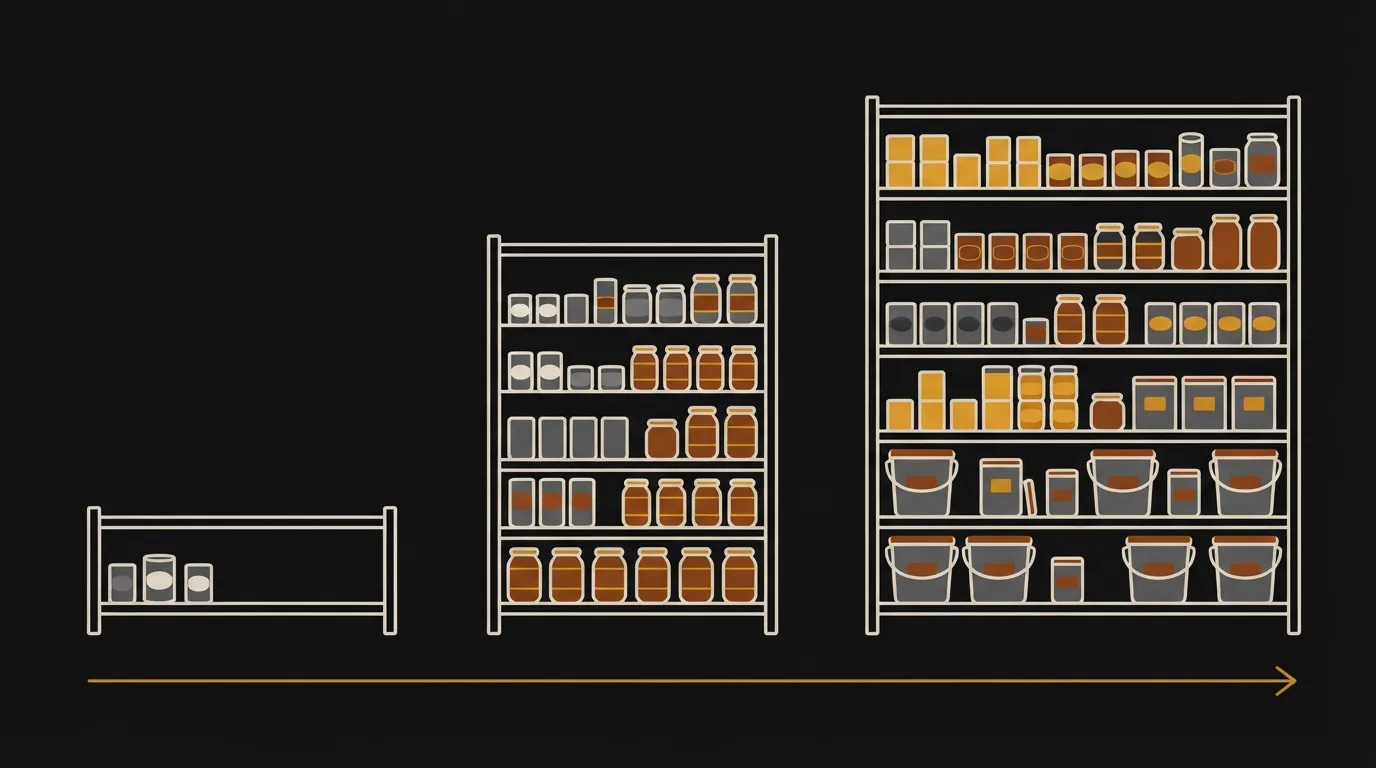
The Church of Jesus Christ of Latter-day Saints, whose members have kept home storage for generations, gives the simplest method of all on its food storage overview. Take what you would buy to feed your family for one day and multiply it by seven. Once you have a week, grow it to a month, and eventually to three months. The same page says the three-month supply should be foods that are part of your normal diet, with wheat, rice and beans saved for the longer-term layer.
Here is how to turn that into a shopping list for your household:
- Write down one ordinary week of dinners, and the breakfasts and lunches that repeat.
- List every shelf-stable ingredient those meals use: pasta, canned tomatoes, rice, canned chicken, beans, peanut butter, oats, flour.
- Multiply each line by 13. Thirteen weeks is 91 days, so that is your three-month quantity.
- Swap the fresh parts of each recipe for canned, dried or frozen versions you know the family will eat.
- Buy one extra week each payday and put the newest cans at the back so the oldest get eaten first.
Ready.gov's food guidance points the same way for shorter emergencies: canned meats, fruits and vegetables, peanut butter, dry cereal and other foods that need no refrigeration and little water, chosen from what your family will actually eat. The advantage is that nothing goes to waste. Every can gets eaten in normal life before it expires, and the supply never becomes a museum in the basement.
Food you cannot cook is not a supply
Dry staples cost water and fuel. Rice takes about twice its volume in water, beans need a soak and a long simmer, and whole wheat needs a grain mill before it becomes flour. A family planning on 400 pounds of grain has to plan the stove, the fuel and the water that go with it.
Ready.gov sets a floor of one gallon of water per person per day for drinking and sanitation. For four people over 90 days, that is 360 gallons, far more than most homes can store in jugs. The practical answer is a stored base plus a way to make more water safe, which our guide to what emergency water filters remove covers in detail. Cooking water comes out of the same budget, so a store heavy in canned food, which carries its own liquid, puts less strain on it than a store of dry beans.
Fuel is the other limit. A camp stove and a few weeks of canisters will not simmer beans every day for three months. If your plan leans on dry staples, store fuel to match, or a way to cook on wood, and run your generator or stove outdoors as our generator safety guide explains.
Calories are the floor, so cover the gaps
A shelf of grain and beans fills stomachs but leaves holes. UGA's extension specialists recommend eating at least one well-balanced meal a day in a crisis and storing vitamin and mineral supplements: 365 multivitamin tablets per person per year, which comes to about 90 tablets each over three months. Their staples list includes 180 grams of vitamin C per adult per year for the same reason. The Church's long-term guide adds that you should store foods containing vitamin C and other nutrients alongside the staples.
Protein deserves a second look too. Beans and grains eaten together cover most needs, and canned meat, fish, peanut butter and powdered milk do the rest. The 1989 Ensign article notes that later studies found smaller quantities of milk adequate when people eat more grain, after families who stored large amounts often let it spoil, so buy the amount of milk powder you will rotate, not the amount a chart prints.
Special needs come first in the plan rather than last. An infant needs formula, and UGA notes that powdered formula is the cheapest form to store, with strict expiration dates. Anyone with diabetes, celiac disease or a food allergy needs a list of their own, built with their doctor's advice, because a store built around wheat can be useless to them.
Where it goes and how to pay for it
Space is the objection that stops most families. Nine to fourteen buckets of grain plus a few cases of cans fit in less room than people expect: a closet floor, the space under two beds, one wall of a cool basement. Heat matters more than tidiness. Utah State University Extension cites USDA figures that shelf life is cut in half for roughly every 11 degrees of temperature rise, so an interior closet beats a hot garage every time. The packing guide covers where to put buckets and how to keep them off concrete.
On cost, the Church's advice is blunt: do not go into debt for food storage, and build it gradually so the expense spreads over time. If you are paid every two weeks and buy one extra week of groceries with each paycheck, you will have three months put by in about half a year. The bulk staples are the cheapest calories in any store, and UGA notes that wheat, corn, beans and salt can be bought in bulk fairly inexpensively, so the sealed layer often costs less than the everyday one.
My take: how I'd build three months for four
I'd start with the everyday layer, because it is the one that gets used. Write the week of dinners, multiply by 13, and buy toward it a week at a time. A family that reaches three months this way has food it will eat without complaint, and a habit of rotating it.
Behind that, I'd put a smaller sealed layer than the charts suggest: perhaps 150 to 200 pounds in all of rice, pinto beans and rolled oats, plus oil, salt and sugar. That alone covers several weeks of calories if the everyday shelf runs out, and it keeps for decades if it stays cool and dry. Wheat I'd add only once someone in the house owns a hand mill and has baked with it.
Last, I'd check the plan against the water and the stove. Count the gallons you can store (our guide to how much water to store per person does that math) and the days of fuel you have, and if the beans need more of either than you hold, shift the balance toward canned food until they match.
When the numbers are settled, the next job is getting the staples into containers that last. Our guide shows how to pack rice, beans and wheat in Mylar and buckets, step by step.
Sources
- Merck Manual: Estimated calories needed by age, sex and activity level (from the Dietary Guidelines for Americans 2020-2025)
- University of Georgia Extension: Preparing an emergency food supply, long term food storage
- The Church of Jesus Christ of Latter-day Saints: Food storage
- The Church of Jesus Christ of Latter-day Saints: Long-term food and water storage
- Ensign, June 1989: Home storage, build on the basics
- USDA FoodData Central: Rice, white, long-grain, regular, raw, enriched
- Ready.gov: Food
- Utah State University Extension: How can I get the most out of my food storage
