Old ways
Unsafe Old Canning Methods, and Why
Open kettle, oven canning, the dishwasher, paraffin on the jelly: which of the methods in old cookbooks you should retire, why a jar can seal and still make you sick, and what to do instead.
Open-kettle canning is unsafe because pouring hot food into jars and capping them, without processing the filled jars in a water bath or under pressure, leaves organisms alive inside a sealed jar, and the same goes for oven, microwave, dishwasher and sun canning, paraffin-sealed jelly and upside-down jars.
Every one of these turns up in older cookbooks, and many families used them for generations. The National Center for Home Food Preservation, which works from USDA research, lists them as not recommended because they do not prevent all risk of spoilage. Below is what each one gets wrong and what replaces it.
Your next step before the next batch: pull up the USDA Complete Guide to Home Canning, which is free to read, and find the tested process for the food you plan to put up. If your family recipe has no processing step, that guide is where you get one.
What open-kettle canning is, and why a sealed jar proves nothing
Open-kettle canning means cooking food in a pot, ladling it hot into jars and screwing the lids down, with no further heating. Illinois Extension notes that older cookbooks taught it and that many people in its canning classes do it today without knowing the name for it.
The method feels safe because the jars pop and seal. The food went in boiling, the lid went on hot, and as the jar cools the air inside contracts and pulls the lid down. That seal is what most people take as the sign of a good jar.
A seal only means air cannot get in. It says nothing about what is already inside. Between the pot and the lid, the food cools, it touches the jar, the ladle, the funnel and the air in the kitchen, and the headspace holds air that was never heated at all. Michigan State University Extension puts it plainly: the jars may seal, but bacteria can survive and multiply inside them, and the food can spoil quickly or make people sick.
Processing the filled jar is what closes that gap. In a canner, the whole jar, contents, headspace and lid, is held at a known temperature for a tested length of time. Illinois Extension adds that jars cooling after a proper process also pull a stronger vacuum, which is one more thing the open kettle gives up.
Why the right heat for the right time matters so much
The organism behind the strict rules is Clostridium botulinum. A review of US foodborne botulism by CDC researchers lays out the conditions it needs: no air, little salt and low acid. A sealed jar of green beans gives it all three.
Its spores are what make home canning a science problem. The same review says the spores are inactivated by heating to 121°C (250°F) under 15 to 20 pounds of pressure for at least 20 minutes. Water boiling in an open pot cannot get past 212°F at sea level, and less at altitude, however long it boils. That is why Illinois Extension sends low-acid foods (meat, vegetables, soups) to a pressure canner that reaches 240 to 250°F, and keeps the boiling-water bath at 212°F for high-acid foods such as jams, jellies, pickles and salsas, where acid holds the spores back.
In the CDC review, covering 1990 to 2000, home-canned vegetables were the most common source of foodborne botulism events in the lower 48 states and Hawaii, 44 percent of them. Asparagus, beets, peppers, beans, corn and greens are all on its list. The toxin does not always change how the food looks or smells.
Oven canning dangers: dry heat and bursting jars
Oven canning means setting filled jars on a rack in the oven and baking them. It shows up in old farm papers and on social media as an easy way to do a big batch without a canner.
It fails in two ways. Dry air carries heat into a jar far more slowly than boiling water or steam, so the center of the jar lags well behind the dial, and nobody has worked out how far behind. MSU Extension says there is no reliable research-based information on what temperature or time to use. MSU also warns that jars can explode when the oven door is opened, cutting or burning anyone nearby and damaging the oven.
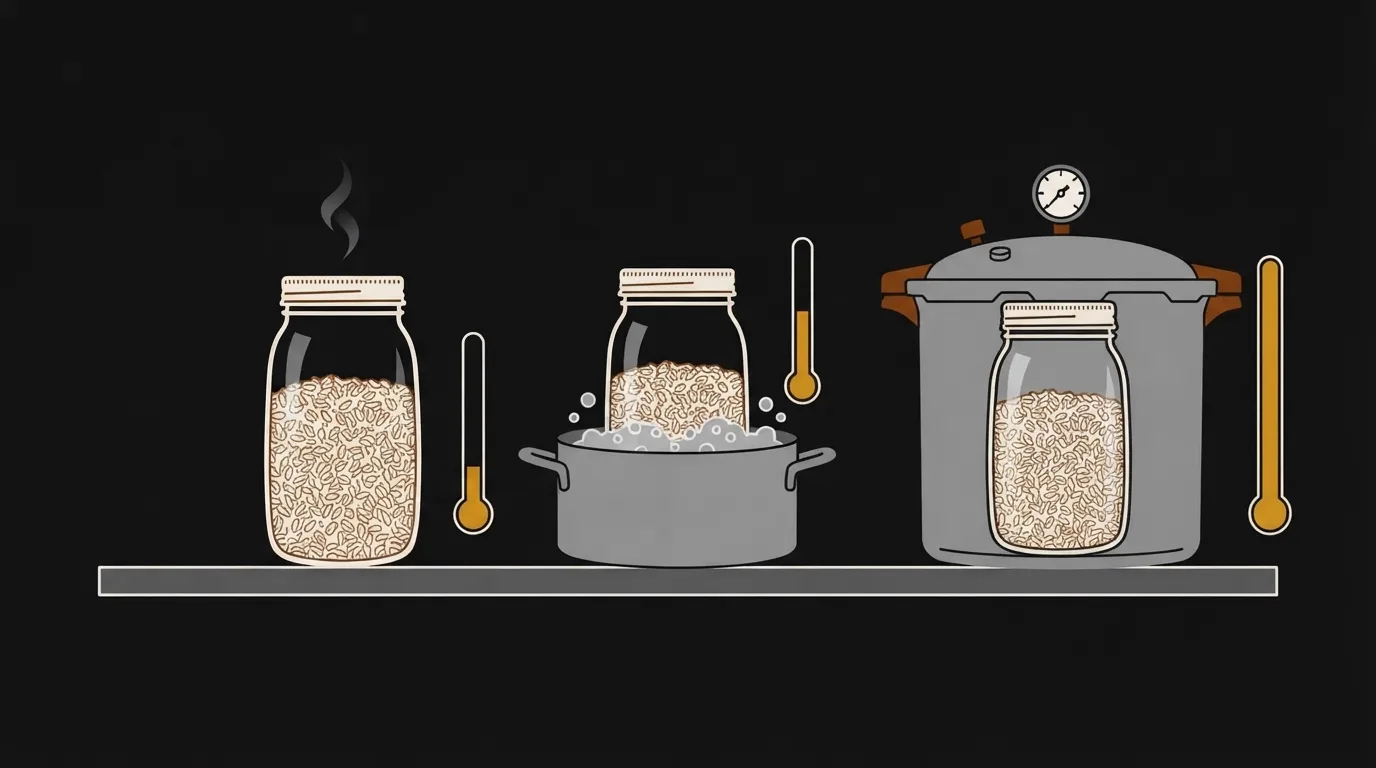
A related trend is "dry canning" dry goods, heating rice, flour or beans in jars in the oven so the lids seal. NCHFP says this is not a science-based way to store dry food either. If long shelf life for dry staples is the goal, oxygen-free packing is the tested route, and our guide to packing rice, beans and wheat for decades covers it step by step.
Dishwasher, microwave and solar canning
These three come up less often, and the answer for each is short.
- Dishwasher: MSU Extension says there is no way to control the temperature or the time, and even the hottest cycle stays far below the heat needed to kill harmful bacteria. A dishwasher is fine for washing jars before you fill them.
- Microwave: microwave ovens heat unevenly and differently from one model to the next, and there are no standards for the temperature inside the jar. NCHFP lists it alongside the oven.
- Solar: heating jars in the sun or in a solar oven has no tested process at all, and MSU lists it among the methods never to use.
Paraffin on jams and jellies, and flipping jars upside down
A disk of melted wax poured over the jelly was the standard seal for generations, and many people still own a block of canning paraffin. MSU Extension says paraffin is no longer an acceptable way to seal jams and jellies. The wax shrinks, cracks or develops pinholes, product seeps onto the surface, and mold grows into the jar.
Scraping off the mold used to be the accepted fix. MSU notes that research has since shown mold on fruit products is not as harmless as people once believed, with a possible risk of mold poisons, even in a high-sugar jam.
Inversion canning, filling hot jars and turning them upside down on their lids to seal, is the newer shortcut, and it is still printed on some pectin-era recipe cards. MSU says it does not reliably seal out contaminants, and when it does seal, the vacuum tends to be weaker than one from a boiling-water process.
The fix for both is small. Ladle hot jam into hot jars, put on two-piece lids and give them five minutes in a water-bath canner once the water is at a full boil, as MSU and the University of Georgia set out. If the jam recipe came from a grandmother's card, you can keep the recipe and add that process.
Old jars, old lids and canning powders
Some of the risk sits in the equipment. NCHFP no longer recommends any of these for canning:
- Glass-lid jars with wire bails. They are good for storing beans, pasta or flour on a shelf, and they make handsome antiques. Tested processes were not built around them.
- One-piece zinc caps, porcelain-lined or with flat rubber rings. Use modern two-piece lids for anything you process.
- Canning powders. NCHFP calls these powders useless as preservatives. They do not replace heat processing.
- Pressure above 15 PSI on new pressure canning equipment. The tested times assume the pressures written in the directions.
Illinois Extension also lists the pressure cooker among unsafe canning methods. A cooker built for dinner is not a pressure canner, and the tested low-acid processes were developed in canners.
Recipe shortcuts that cause the same problem
A safe canner can still turn out an unsafe jar when the recipe is changed. NCHFP warns against packing vegetables or other food pieces without the covering liquid used in the research, a practice sometimes also called dry canning. Without the liquid, heat moves through the jar differently, the center can be under-processed, and with vegetables the result is a botulism risk.
The tested processes come as a package: the food, the way it is cut, how it is packed, how much liquid covers it, the jar size, the headspace, the canner, and the time adjusted for your altitude. Change the pack and the time on the page no longer applies to your jar.
Steam canners: the one old warning that has changed
Older extension handouts list the atmospheric steam canner as not recommended, and you will still see it on lists of unsafe methods. NCHFP says research done with the University of Wisconsin has since found many products suitable for a steam canner, as long as certain critical controls are kept at each step.
MSU Extension narrows that to high-acid foods: fruit, pickles and acidified tomatoes. A steam canner is not pressurized and cannot replace pressure processing for vegetables, meat or soup. If you own one, use it with the University of Wisconsin directions that NCHFP links.
What to do with jars already on the shelf
Illinois Extension answers the question many readers have: if the open-kettle jars sealed, are they safe? Its answer is no, because they were never processed to destroy what was inside.
Sort them by what is in them. Low-acid jars of unknown processing, such as beans, corn, beets, other vegetables, meat and soup, are the ones the botulism record points to, and they are not worth the risk. Never taste a jar to decide. For high-sugar jams under paraffin, look for mold under the wax and around the rim, and treat any jar that has it as spoiled.
Your county extension office can tell you how to throw out suspect jars without spreading what is in them, and many offer canning classes and pressure-gauge testing.
My take: what to keep from the old ways, and what to drop
I'd keep the family recipes and drop the family processing. The recipe gives you the flavor. The time and temperature come from a tested guide, and the two fit together more often than people expect. A jam card that says "seal with wax" becomes a five-minute boiling-water bath. A bean recipe that says "pack hot and cap" gets processed under pressure for the time the USDA guide gives.
If you are setting up to put food by for a household, I'd buy the pressure canner before anything else on the canning list. It is the only piece of equipment that makes vegetables, meat and stock safe to keep on a shelf, and those are the jars that matter most when the store is closed. A boiling-water canner handles the fruit, pickles and jam.
Your one step: open the USDA Complete Guide to Home Canning and match each family recipe to a tested process before canning season. More pre-grid skills, with what still holds up and what does not, are in the old ways section.
Sources
- National Center for Home Food Preservation: Equipment and Methods Not Recommended
- Michigan State University Extension: Downright unsafe canning methods
- Michigan State University Extension: Processing jams and jellies
- Illinois Extension: Why is open kettle canning unsafe?
- Sobel and others, CDC: Foodborne Botulism in the United States, 1990-2000 (Emerging Infectious Diseases)
