Food storage
Food Storage Mistakes That Quietly Ruin a Stockpile
Most stored food is lost to where it sits and how it was packed, years before anyone opens it.

Stored food rarely fails all at once. It goes bad because it sat somewhere hot, picked up moisture, kept its oxygen, let insects in, or simply aged past its usefulness on a shelf nobody rotated. Fix those five things and a stockpile of rice, wheat and beans can stay good for decades. Ignore them and the same food may be stale, rancid or crawling within a few years.
Below are the mistakes that do the most damage, roughly in the order they cost people food, each with the fix and a link to the page on this site that covers the fix in full. If you are reading this because you just opened a bucket and something was wrong, skip to why your stored food went bad, which works backward from what you found.
Keeping food in the garage or the attic
Heat is the quiet one. A bucket in a 95-degree garage looks exactly like a bucket in a cool closet, and nothing tells you it is aging several times faster. Utah State University Extension summarizes Brigham Young University's long-term storage work with one comparison: wheat kept acceptable quality for 25 years stored cold in a basement and only 5 years stored hot in a garage or attic. White rice tells the same story. USU's rice page puts it at up to 10 years sealed at a constant 70 degrees and up to 30 years in cooler storage.
The rule of thumb behind those numbers is a USDA figure that USU repeats: shelf life roughly halves for every 11 degrees of temperature rise. So a garage that sits at 90 for three months a year is eating years off the food in it, even if it is mild the rest of the time. Daily swings make it worse. A garage that cools at night and bakes in the afternoon pushes moisture around inside containers, and cans sitting on a cold slab sweat and rust.
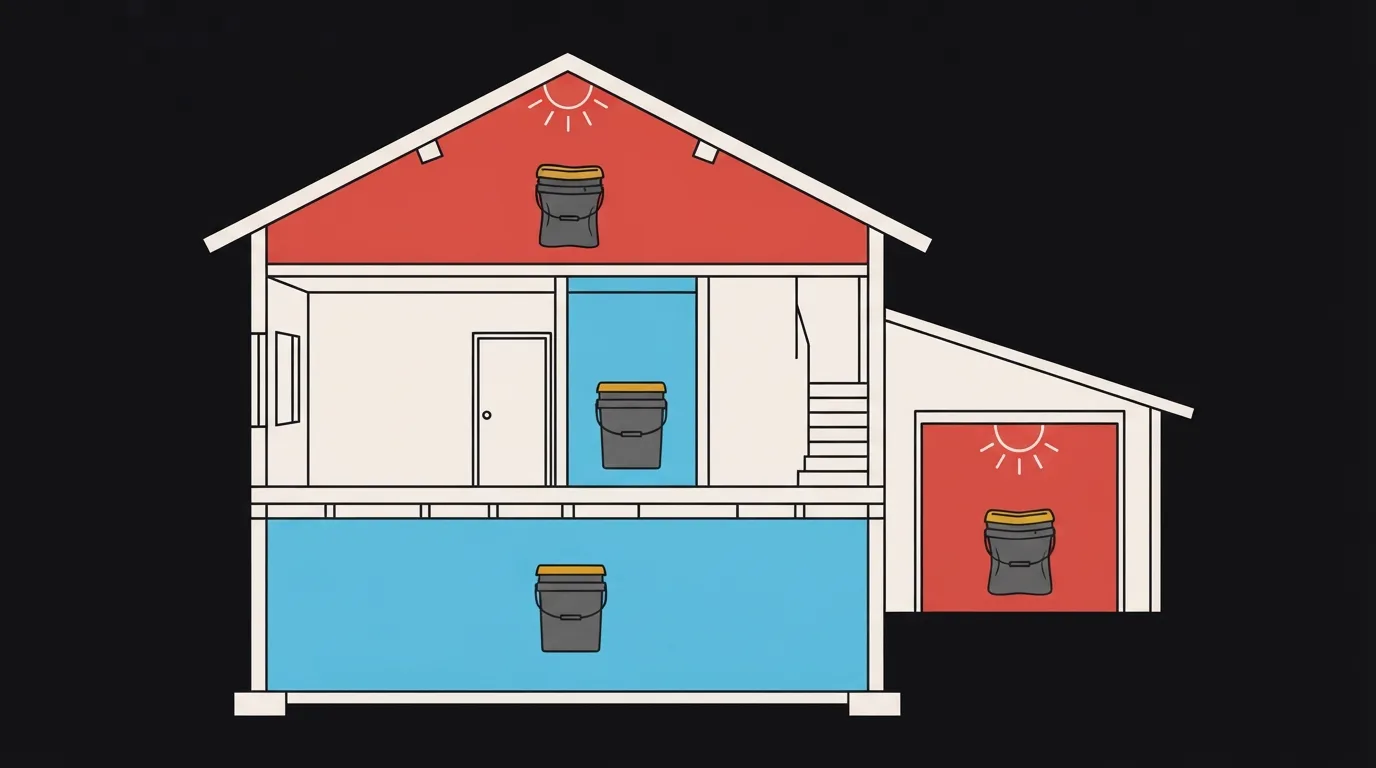
The fix: store food inside the living space and move other things out to make room. An interior closet, a basement wall away from the furnace and water heater, or the space under beds all stay closer to the 40 to 70 degree range. If the garage is truly the only room you have, give it the food you will eat within a year and the water drums, and keep the sealed long-term layer in the house. Our shelf life chart lists how long each staple keeps under good conditions, which is the number a hot garage cuts into.
Setting buckets and cans on bare concrete
Concrete feels like the obvious place for heavy buckets. USU advises against it: flooring, and concrete in particular, can leach chemicals into stored food, those chemicals can pass through plastic, and they cause rust on metal. A slab also wicks moisture and cold, so a basement floor that looks dry can still be damp enough to corrode the bottom rim of a #10 can over a few years.
Moisture in the room is its own problem. USU's storage page says that if dried food picks up moisture from the storage area, molds and bacteria can grow, and in humid areas a dehumidifier may be needed. Paper sacks soak it up fastest, so flour or rice headed for long-term storage comes out of its store bag first.
The fix: put everything on shelving, pallets or a few strips of lumber so air moves under it. Keep the room dry, and run a dehumidifier in a damp basement through the humid months. For packing food so the room's humidity cannot reach it at all, follow the bag-in-bucket method in how to pack rice, beans and wheat to last 30 years.
Sealing food with its oxygen still inside
A snapped-on bucket lid keeps out mice and dust. It does very little about the air already inside, and that air is about 21 percent oxygen. Oxygen slowly oxidizes fats and vitamins, and it lets any insect eggs already in the grain hatch and grow. Food packed this way is fine for a year or two of rotation. It is not a 20-year store.
The most common version of this mistake is using an absorber that is too small or already spent. A five-gallon Mylar bag needs far more than the 300 cc packet that comes taped to some bags, and absorbers start working the moment they touch room air, so a packet left open on the counter while you fill buckets may be half used before it goes in. The Church of Jesus Christ's long-term storage guidance adds a less obvious point: absorbers do little in a plain plastic bucket with no liner, because plastic lets a small amount of air through its walls over time.
The fix: seal dry food in Mylar or #10 cans, size the absorbers to the container and the food with our oxygen absorber calculator, and open the absorber pack only after every bag is filled. Check the bags two days later. A working bag pulls tight against the food. A loose one needs a fresh absorber and a new seal.
Putting moist food in an oxygen-free bag
This mistake can make people sick, which puts it in a different class from the rest. The bacteria that cause botulism grow in exactly the low-oxygen conditions an absorber creates, and USU Extension warns that botulism poisoning may result when moist products go into packaging that removes oxygen. Dry goods for oxygen-free storage should be at 10 percent moisture or less.
The foods that get people into trouble are the ones that feel dry but are not: home-dehydrated vegetables that still bend, fruit leather, jerky, brown sugar and anything baked. Store-bought white rice, wheat, beans and pasta are already dry enough.
The fix: only brittle, snap-dry food goes into a sealed Mylar bag with an absorber. Moist food that has to live on a shelf gets canned by a tested process, and our page on old canning methods that are no longer safe covers the shortcuts that do not count.
Sealing up brown rice and other oily foods
Brown rice is the most common casualty here. Its bran layer holds oil, and that oil goes rancid long before the starch inside is in any trouble. BYU's 30-year results are for polished white rice, which has the bran milled off. The Church's long-term storage chart lists brown rice among the foods that are not suited to long-term storage, along with whole wheat flour, milled grains other than rolled oats, granola, nuts, pearled barley, dried eggs, brown sugar and soft dehydrated produce.
An absorber slows rancidity but does not stop it, so a sealed bucket of brown rice will still smell like old paint long before a bucket of white rice from the same week changes at all. Whole grains are the exception worth knowing: whole wheat berries keep for decades because the oil stays sealed inside the kernel until you grind it.
The fix: keep brown rice, whole grain flour and nuts in the kitchen pantry or the freezer, buy them in amounts you will use within months, and put white rice and whole wheat berries in the long-term buckets. Grind wheat as you need it.
Adding oxygen absorbers to sugar and salt
Sugar, salt and baking soda already keep indefinitely if they stay dry. Nothing in them needs protecting from oxygen, and USU's sugar page says plainly that removing oxygen for long-term sugar and honey storage is not required and not recommended. What absorbers tend to do instead is set granulated sugar into one hard brick, which then has to be chipped out of the bag.
Moisture is the real enemy of stored sugar. USU notes it makes granulated sugar hard and lumpy, and that sugar can pick up strong odors even through plastic, so a bucket of sugar stored next to the gasoline cans or the laundry soap may come out tasting of both. Brown sugar carries its own moisture and does not store well for the long term at all.
The fix: store white sugar and salt in airtight, odor-proof containers (Mylar, food-grade buckets, glass jars) with no absorber, in a dry spot away from anything with a smell.
Leaving food where insects and mice can reach it
Pantry insects usually arrive in food from the store, not from outside. Weevils lay eggs inside whole kernels, where you cannot see them, and Indian meal moth larvae feed on grain products, dried fruit, nuts and powdered milk. Texas A&M AgriLife's entomologists point out that ordinary metal kitchen canisters are not tight enough to exclude some insects, and even sealed packages can be loose enough for them to get in and out.
Mice compound the problem. They chew through paper sacks and thin plastic, and the same extension sheet notes that mice hoard seeds and other stored products that later become infested, so a nest in a wall can keep a beetle problem going after the pantry itself is clean. Pet food and birdseed stored next to the human food are frequent sources.
The fix: freeze new grain, flour and beans at 0 degrees for three to four days to kill eggs and larvae, as USU recommends, and let the bags warm to room temperature before opening them so condensation does not form on the food. Store everything in thick plastic, glass or metal containers with gasketed lids, or in sealed Mylar inside a bucket. Keep pet food in its own sealed bin, sweep up spills under shelves, and set traps if you see droppings. TAMU's simplest prevention advice is to use dried food within two to four months of purchase unless it is sealed for storage.
Never rotating, never labeling
A stockpile that nobody eats from turns into a pile of expired food. Canned goods are where this bites hardest. USU puts commercial cans at their best quality up to the code date, usually two to five years from manufacture, with high-acid foods such as tomatoes and fruit at the short end. Home-canned food is best within a year and used before two. Vitamins A and C fade by 5 to 20 percent a year even inside a sealed can.
Unlabeled buckets are the other half. Five years from now nobody remembers which bucket of rice was packed in a humid August and which went in with a fresh absorber, and an unlabeled can is impossible to rotate.
The fix: write the contents and the month and year on every can, bag and bucket lid. Put new purchases at the back and take from the front. Cook from the store every week, so cans move through the kitchen inside their best-quality window and the sealed buckets get opened and replaced on a schedule. Our shelf life chart gives the rotation window for each food.
Letting canned food freeze
Dry food can freeze without harm. Cans cannot. USU warns that freezing bulges cans and may cause seam failures that open the way to foodborne illness. That makes an unheated garage, shed or barn a poor home for canned goods in a northern winter, even where summer heat is not a problem. Water stored in the same space has its own freeze issues, covered in our guide to keeping stored water from freezing.
The fix: keep cans somewhere that stays above freezing all winter. Throw out any can that has bulged, leaks, spurts when opened or has deep rust on a seam, without tasting it.
Storing food you cannot cook or will not eat
The last mistake does not spoil food. It spoils the plan. A bucket of wheat with no grain mill is not flour, and fifty pounds of dry beans need water and hours of fuel to become a meal. Old beans also harden with age and take longer to soften, which costs even more of both. Families who store what they do not normally eat also find out in an emergency that the children will not touch it.
The fix: store what your household already cooks, and store the means to cook it: water, fuel, a manual can opener and, for wheat, a hand mill. Size the whole thing with our guide to how much food a family of four needs for three months or the family food and water storage calculator, which adds the water alongside the food.
Why your stored food went bad: what the signs point to
When you open storage and find a problem, the symptom usually names the mistake:
- A sharp, painty or bitter smell means rancid fat. Look for oily food in long-term storage (brown rice, flour, nuts) or a container that sat somewhere hot.
- Live insects, webbing or fine powder mean eggs came in with the food and found enough oxygen to hatch, or the container let pests in. Freeze or discard, clean the shelf, and check nearby containers.
- A Mylar bag that has gone soft and loose means a leak or a spent absorber. Open it, inspect the food, and repack it if it smells and looks normal.
- Clumps, mold or a musty smell point to moisture: food packed on a humid day, a damp floor, or a bucket stored where condensation forms.
- Sugar or salt set into a solid block means moisture got in, or an absorber went into the bag. It is still safe to use.
- Bulging, leaking or rust-seamed cans mean the can has failed, from age, heat or freezing. Discard without tasting.
- Beans that stay hard after hours of cooking are simply old. They are safe, and a long soak and a pressure cooker help.
My take: where I would look first
I'd start with the thermometer, because heat is the mistake that costs the most food and shows the fewest signs. Put a cheap min/max thermometer where the food lives and read it in late July. If it shows anything near 90, moving the food indoors will do more for it than any new container or absorber, and I'd skip buying more buckets until that move is made.
After that I would pull every bag of brown rice, flour and nuts out of the long-term buckets and into the kitchen, where it will be eaten while it is still good. Then I would label everything and start cooking one meal a week from storage. That habit alone catches most of the other mistakes on this page, because a stockpile you open regularly cannot quietly go bad for ten years.
Sources
- Utah State University Extension: Food storage conditions
- Utah State University Extension: Storing white rice
- Utah State University Extension: Storing sugars
- Utah State University Extension: How can I get the most out of my food storage
- Utah State University Extension: Storing canned goods
- Texas A&M AgriLife Extension: Recognizing and controlling insect pests of stored products
- BYU Magazine: Ask an expert, new tips for old food
