Food storage
Oxygen Absorber Calculator
Pick the bucket, jar or bag, the food going in and how full it is. You get the cc of absorber it needs and the packets that add up to it.
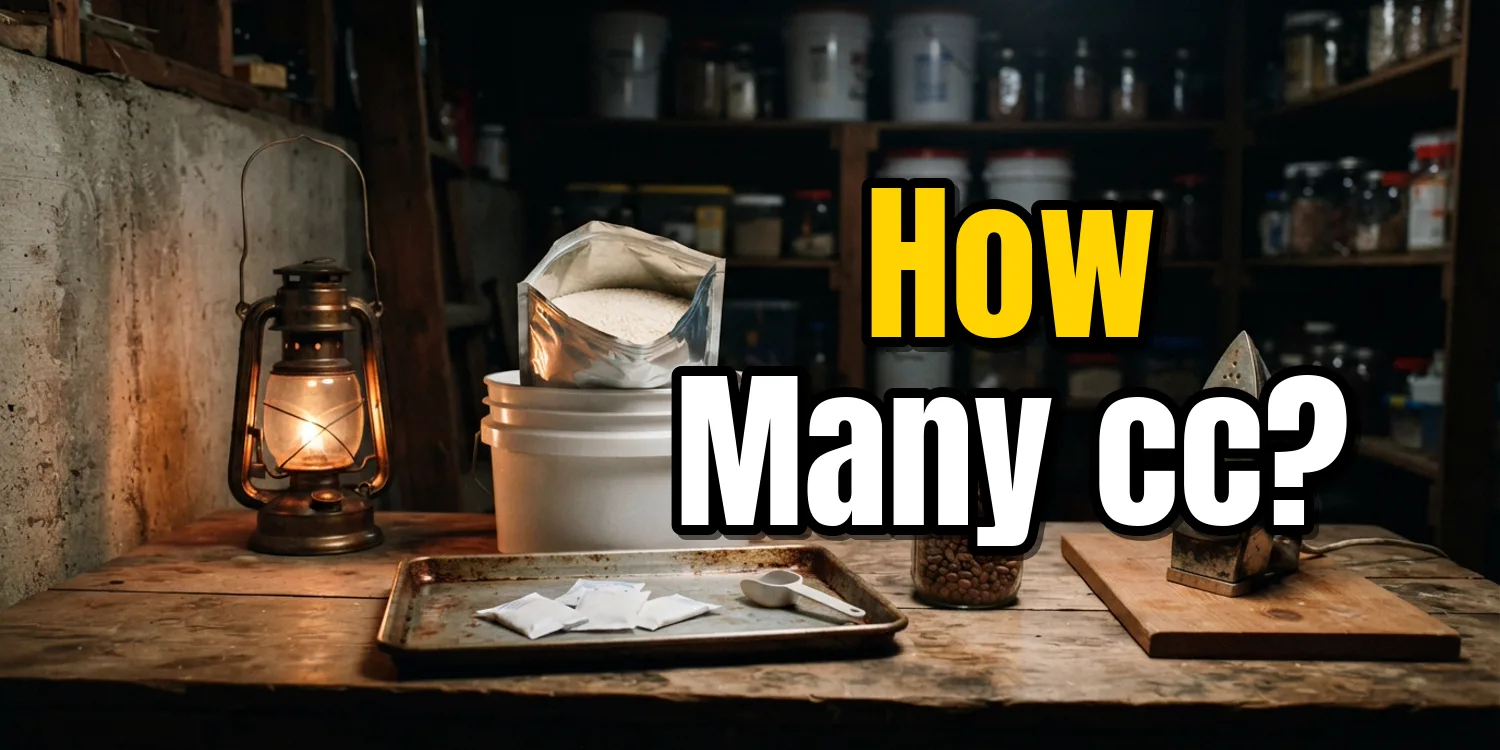
A 5-gallon Mylar bag of rice, wheat or dry beans filled near the top needs at least 1,500 cc of oxygen absorber, and 2,000 cc gives you a safe margin. A quart mason jar of the same food needs one 100 cc packet. Those figures come from the 300 cc per gallon that the Church of Jesus Christ of Latter-day Saints uses in its home storage packing, checked against the air in the container. Pick your own container and food below to get the number for your batch.
The packing itself, from filling the bag to ironing the seal, is laid out in our guide to packing rice, beans and wheat to last 30 years. This page covers the part that guide leaves to the maker's chart: the size of the packet.
How the calculator gets its number
An oxygen absorber is a packet of iron powder. Moisture in the food makes the iron rust, and rusting iron takes oxygen out of the air around it. The packet's rating in cubic centimeters (cc) is how much oxygen it can take up, so a 300 cc absorber removes 300 cc of oxygen and then stops. The job is to match that rating to the oxygen sealed in with the food.
The Church's long-term storage guide gives the base figure. It says absorbers rated for 300 cc work well for properly packaged dry food in containers of up to 1 gallon, and it uses one such packet in each 1-gallon foil pouch, whether the pouch holds 7 pounds of wheat, 6.8 pounds of white rice or 5 pounds of dry milk. The calculator scales that to your container: 300 cc for every gallon of grain, beans or powder packed full.
You can check the figure against the air. Air is about 21 percent oxygen. A gallon is about 3,785 cc, so 300 cc of oxygen is what you would find in roughly 1,430 cc of air, or 38 percent of the gallon. That is the share left as air between the kernels and above them when a container of dry grain is packed full. Food shaped like pasta, elbow macaroni or dried carrot slices leaves wider gaps, so the calculator gives it half again as much, 450 cc a gallon. That step-up follows the size chart Ready Nutrition published from Tess Pennington's packing guide, where pasta takes the biggest packets of any food.
Empty space counts at full value. A gallon of plain air holds about 795 cc of oxygen, so a container only half full of food carries far more oxygen than a full one. When you pick three quarters or half full, the calculator charges the empty part at 795 cc a gallon and the filled part at the food's rate.
Then it adds a quarter. That buffer is our own rounding, for the minutes an absorber sits in room air before the seal closes and for a bag that holds more air than it looks. Ready Nutrition's advice is the same in plain words: since head space and void space cannot be measured exactly, use the larger size when in doubt. Extra capacity costs a few cents and does no harm to the food. Too little leaves oxygen behind, and with it the insects and stale flavor the absorber was meant to stop.
Last, it picks packets. Absorbers are commonly sold in 100, 300, 500, 1,000 and 1,500 cc sizes, so the result names a mix of those that reaches the total with as few packets and as little waste as it can. Two packets of different sizes do the same job as one big packet of their combined rating.
A worked example: one 5-gallon bucket of rice
Take a food-grade 5-gallon bucket with a Mylar bag inside it, filled with white rice almost to the rim and the air pressed out by hand before sealing.
- Container volume: 5 gallons, which is about 18,925 cc.
- Food rate: white rice packed full takes 300 cc a gallon, so 5 × 300 = 1,500 cc. That is the minimum.
- Buffer: 1,500 × 1.25 = 1,875 cc.
- Packets: the nearest mix above 1,875 is one 1,500 cc and one 500 cc packet, 2,000 cc in all. Two 1,000 cc packets do the same.
That 2,000 cc lands on the figure most suppliers print for a 5-gallon bag, which is why it has become the usual rule of thumb. Fill the same bag only halfway and the number jumps: 2.5 gallons of rice at 300 cc plus 2.5 gallons of air at 795 cc comes to about 2,740 cc before the buffer. A half-empty bag needs more absorber than a full one, and a smaller bag sized to the food is the better fix.
Oxygen absorber size chart
These are the calculator's results for common containers packed full. The first number is the minimum, the second is what to put in after the buffer, rounded up to packets you can buy.
| Container | Grain, beans | Pasta |
|---|---|---|
| Pint jar | 38 / 100 | 56 / 100 |
| Quart jar | 75 / 100 | 113 / 300 |
| Half-gallon jar | 150 / 300 | 225 / 300 |
| 2-liter bottle | 158 / 300 | 238 / 300 |
| 1-gallon bag | 300 / 500 | 450 / 600 |
| #10 can | 310 / 500 | 465 / 600 |
| 5-gallon bag | 1,500 / 2,000 | 2,250 / 3,000 |
| 6-gallon bag | 1,800 / 2,300 | 2,700 / 3,500 |
Flour, powdered milk and potato flakes take the same numbers as the grain column. All figures are in cc.
Why some charts say 750 cc for a 5-gallon bucket
Search for an absorber chart and you will find 5-gallon figures anywhere from 750 cc to 2,500 cc. The low ones mostly trace back to one worked example that circulates on seller and blog pages. It weighs 35 pounds of rice, converts that to 15,876 grams, treats those grams as 15,876 cc of rice, subtracts that from the bucket's 18,942 cc and gets about 3,070 cc of air, which works out to 630 cc of oxygen. BayTec Containers and Ready Nutrition both print it.
The step that fails is grams into cubic centimeters. A gram fills one cubic centimeter only for water, and BayTec's own page admits the method assumes the food has the density of water. Rice kernels are heavier than water, which is why rice sinks to the bottom of the pot. So 35 pounds of rice takes up less room than 15,876 cc, and the air between the grains is larger than the example allows. The 300 cc per gallon the Church uses on dry food is about twice as generous, and I would trust the larger figure. A packet that is too big wastes a little money. One that is too small leaves a bucket that never pulls tight.
Oxygen absorbers in mason jars
Glass canning jars are one of the four containers the Church lists for use with absorbers, with the condition that the metal lid has a gasket. The two-piece lids sold for home canning have a ring of sealing compound on the underside that does that job. Mason jars suit a pantry shelf: a quart of rice, oats or beans is a week of side dishes, you can see the food, and mice cannot chew through them.
- Fill the jar to about an inch below the rim and tap it on the counter to settle the food.
- Drop a 100 cc packet on top for a pint or quart of grain or beans, or a 300 cc packet for a half-gallon jar or a quart of pasta.
- Wipe the rim dry, put on a new flat lid and screw the band down firmly by hand.
- Within a day or two the lid usually pulls down and stops flexing when pressed, because the absorber has taken the oxygen and left a partial vacuum. A lid that still pops up and down has a leak or a spent packet.
Jars do not go through a canner for this. Heat adds nothing to dry food in a sealed jar, and the National Center for Home Food Preservation lists heating dry goods in jars in the oven as one of the methods it rejects. Light is the jar's one weakness, so keep them in a closed cupboard or a box, and use a new absorber every time you refill a jar, as the Church advises for bottles.
Foods to pack without an absorber
Sugar, salt and baking soda keep indefinitely when dry, and the Church lists sugar's shelf life as indefinite. An absorber in a bag of sugar tends to set it into one solid block, so seal these in a bucket or Mylar bag without one.
Anything moist must never go into an oxygen-free container. The Church's warning is direct: botulism poisoning may result if moist products are stored in packaging that reduces oxygen, so the food must be about 10 percent moisture or less. The botulism germ grows where there is no oxygen, which is the very condition an absorber creates. Dried vegetables and fruit qualify only when they are dry enough to snap when bent, inside and out. Utah State University Extension puts the same 10 percent ceiling on dry goods packed with an absorber.
Oily foods such as brown rice, nuts, granola, whole wheat flour and jerky are on the Church's list of dry products not recommended for long-term storage. An absorber slows the fat from going rancid but cannot stop it, and jerky belongs with the cured and dried meats, not the grain buckets. The calculator answers with a warning when you pick this group. Keep them in the pantry you rotate, and look up how long each lasts in our food storage shelf life chart.
A plastic bucket with no Mylar liner
Absorbers do nothing useful in a plain plastic bucket. The Church says outright that they are not an effective treatment for plastic buckets, milk jugs or any plastic bottle not marked PETE or PET, because those plastics let oxygen seep back in through the walls and the absorber simply keeps working until it is spent. Food-grade buckets are still the right outer shell. The barrier comes from the Mylar bag inside, which the bucket protects from rodents and punctures.
If you are storing wheat or beans in buckets without liners, the Church's method is dry ice instead of an absorber: about 1 ounce per gallon of bucket, set in the bottom under the grain, with the lid snapped only halfway until the ice is gone. A 5-gallon bucket takes about 5 ounces. Never seal a lid down on dry ice that is still giving off gas, and never use it in a metal can.
Working with absorbers on packing day
An absorber starts working the moment it meets room air, and it cannot tell the difference between the oxygen in your bag and the oxygen in your kitchen. That makes the order of work the most important thing on packing day.
- Fill and stage every bag or jar first, with the iron hot and the lids laid out.
- Cut open the top of the absorber pack, never the small packets inside.
- Take out only what you will use in the next 20 to 30 minutes, the window the Church gives, and spread them on a tray. I would aim for the short end of that window and work in small batches.
- Reseal the rest of the pack straight away.
- Drop one packet, or the mix the calculator gave you, on top of the food in each container, press out the air and seal.
A fresh absorber feels soft, and the powder shifts when you squeeze it. One that has gone hard or lumpy, or is warm in the hand before it reaches a bag, has already been working on room air. Use it on the next container only if you can add a second packet to make up the shortfall. Many packs come with an indicator tablet that changes color when oxygen gets in: read the key printed on your pack, because the colors differ between makers.
A bag with a working absorber pulls in against the food within a few days. The Church notes this shows more with granular foods like rice than with powders like flour, so a bag of flour that only tightens a little is not necessarily a failure. A bag of rice that is still loose after a week needs opening, a fresh packet and a new seal.
Storing an opened pack of absorbers
Spare absorbers keep only as long as you keep air away from them. The Church gives three ways to reseal an opened pack, and it rules out the obvious one: do not store absorbers in zip-top bags, which let enough air through to use them up.
- Heat-seal the original bag with an impulse sealer or the same iron you use on your Mylar bags, pressing out the air first.
- Clamp the bag shut with a bag clamp made for the job, if your supplier sells one.
- Move them into a glass canning jar with a gasketed metal lid. A pint jar holds about 25 absorbers, and the lid will usually pull down within a day as the packets use up the little air in the jar. That pulled-down lid tells you the rest are still good.
Buy absorbers in pack sizes close to what one packing day uses. A pack of 100 small packets for one pantry shelf of jars will sit half-used for months, and every opening costs the remainder some capacity. Label the storage jar with the cc rating and the date you opened the pack.
My take
I would run every packing day off two numbers: 300 cc for each gallon of grain or beans, and 2,000 cc for a full 5-gallon bag. Round up rather than down, and never try to make a short pack of absorbers stretch across one more bucket. Fill bags full and size the bag to the food, because headspace is where most of the oxygen hides. For a family starting out, I would buy one pack of 2,000 cc absorbers for buckets and one pack of 100 cc for quart jars, and store the leftovers in a pint jar the same day.
If you have not worked out how many buckets you need in the first place, start with our food and water storage calculator, which turns your household and a length of time into pounds of grain and beans. For a family that wants a target rather than a formula, our guide to how much food a family of four needs for three months breaks the total into shelves.
Sources
- The Church of Jesus Christ of Latter-day Saints: Long-term food and water storage
- Utah State University Extension: Getting the most out of food storage
- National Center for Home Food Preservation: Equipment and methods not recommended
- Ready Nutrition: Oxygen absorber size chart
- BayTec Containers: Measuring volume of oxygen absorbers needed
