Old ways
Preserving Meat Without a Refrigerator
Salt, smoke, drying and fat kept American households in meat for centuries. Here is how each one works, what it still does well, and where modern food-safety guidance draws the line.
To preserve meat without refrigeration, you take water out of it and keep it away from bacteria: a heavy salt cure held in cold weather for weeks, then drying, smoke and months of hanging, or thin strips dried hard into jerky. Of the old methods, only a full dry cure produces meat that keeps for months at room temperature, and storing moist meat under lard is the one modern food scientists warn against outright.
That second sentence matters as much as the first. Our grandparents' grandparents did all of this, and most of it worked because they worked inside limits they knew by habit: butcher in December, use plenty of salt, hang the hams where flies could not reach them. Those limits are written down now in university extension publications, and they are the difference between a country ham and a crock of spoiled meat.
What salt, smoke and fat each do
Fresh meat is mostly water and protein, which is exactly what bacteria and molds want. Every old method attacks one part of that.
Salt pulls water out of the muscle and ties up what is left, so microbes cannot use it. The National Center for Home Food Preservation describes curing as using salt, sometimes sugar, and seasonings to draw moisture out of meat and make it hostile to harmful microorganisms. Salt does the heavy lifting in every traditional cure. Sugar softens the harsh taste, and nitrate or nitrite gives the pink color and the cured flavor.
Smoke dries the surface, colors it and leaves compounds behind that slow surface spoilage. It adds a layer of protection to meat that has already been salted. Smoke on its own, over fresh meat, does not make it keep.
Drying removes water by air and low heat instead of salt. Thin strips of lean meat dried until they crack when bent are jerky, the lightest form of preserved meat there is.
Fat seals air out. Rendered lard has had its water cooked away, and it keeps well in a cool pantry. Meat sealed under it is another matter, covered further down.
How pioneers preserved meat
Hog killing on a farm waited until the weather turned reliably cold, usually late in the year. The carcass chilled overnight in the open air, the hams, shoulders and sides were cut, and they went straight into salt. Some families packed sides in a wooden box of dry salt, others put pork into barrels of brine strong enough to cure it. Once the cure was done, the meat was hung in a smokehouse and smoked over a slow hardwood fire, then left to hang through spring and into summer.
On the overland trails, what emigrants called bacon was often salt pork. Writing for the Institute of Food Technologists' student association, Science Meets Food explains that trail "bacon" meant any heavily salted cut from the sides, hams or shoulders, frequently unsmoked, kept in barrels of brine and soaked before cooking to draw out the excess salt. Fatty pieces spoiled as the fat melted in summer heat, and some guidebooks told travelers to pack the meat in wheat bran to insulate it. Dried meat learned from Native peoples traveled west too, though in far smaller amounts than salt pork.
What the history leaves out is how much meat was lost. Hams went bad at the bone, insects got into the smokehouse, and a warm spell during the cure could spoil a whole season's work. The old methods survived because families accepted that risk. You can keep the methods and drop most of the risk.
Salt curing meat: the dry cure
The dry cure is the method behind country ham and old-fashioned side meat, and it is the one with the clearest modern instructions. Virginia Cooperative Extension's guide to dry curing Virginia-style ham is written for home curers and follows the same steps a farm family used, with temperatures attached.
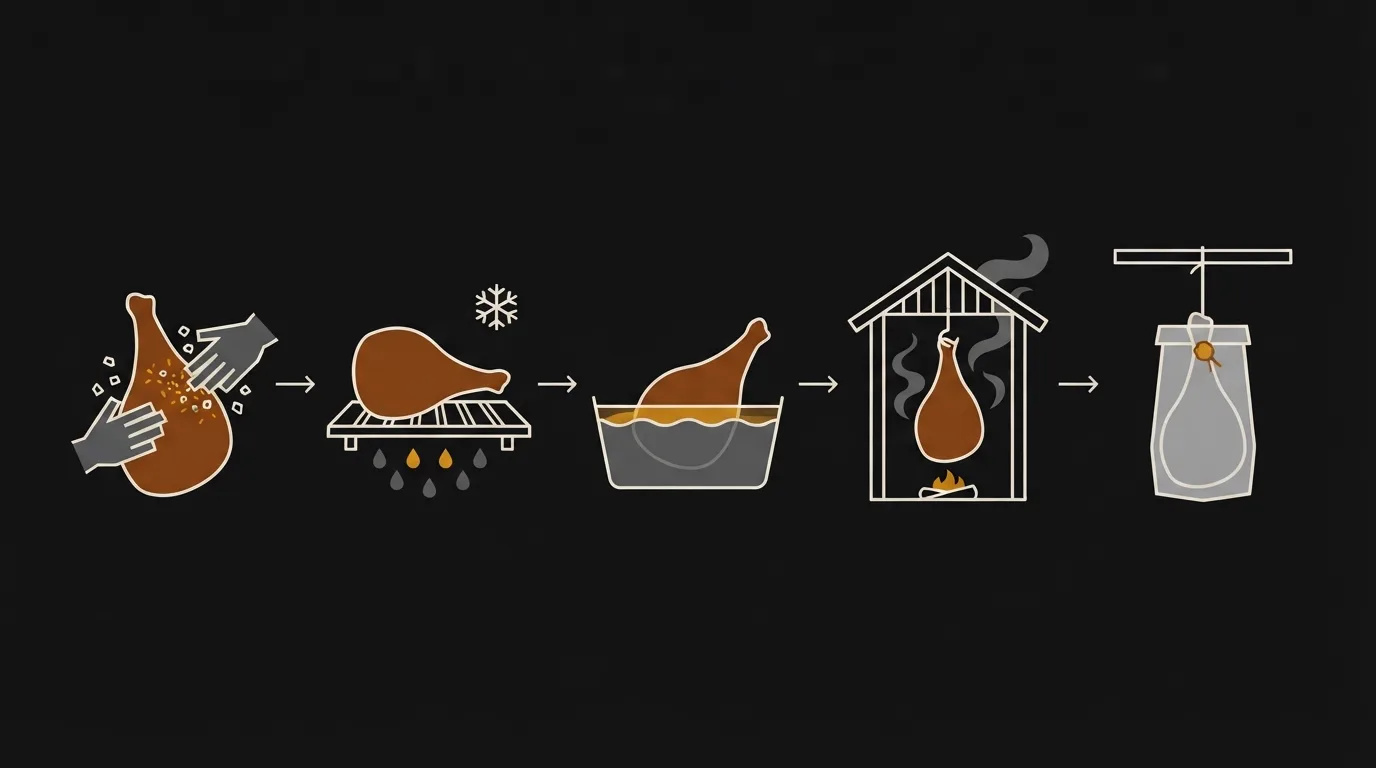
- The cure mix. For every 100 pounds of fresh meat, Virginia Tech uses 8 pounds of salt and 2 pounds of sugar, with a weighed amount of saltpeter or nitrite cure. It notes that salt alone is acceptable.
- Applying it. Split the mix in two. Rub the first half into every lean surface on day one and the second half on day seven. Pack the exposed shank end and the area around the aitchbone, where spoilage at the bone (bone sour) starts.
- Curing time. Seven days per inch of thickness at the thickest part, or a day and a half per pound. A ham 5 inches thick takes about 35 days.
- Temperature. The meat must stay at 36 to 40°F the whole time, read on a thermometer. Mississippi State gives 32 to 40°F as the best range.
- Soak and equalize. Soak the ham an hour in cold water, scrub it, and hold it at 50 to 60°F for about two weeks so the salt spreads evenly through the meat.
- Age. Hang it for 45 to 180 days at 75 to 95°F and 55 to 65 percent humidity with moving air. It loses roughly another 8 to 12 percent of its weight.
Two details catch beginners out. The meat has to drain: Mississippi State Extension says to cure on shelves or in open wooden boxes, never in a tight barrel where the meat sits in its own brine. And nitrite is a dose, measured by weight. Mississippi State warns that too much nitrate and nitrite can be toxic, and that USDA does not allow nitrate in bacon. Most people today buy a premixed commercial cure and weigh it to the recipe instead of mixing their own.
Bacon is easier than ham. Mississippi State rubs the whole belly with half the nitrite strength used for hams, cures it on the same days-per-inch schedule, and notes that bacon does not need aging. A belly is far thinner than a ham, so its cure takes weeks rather than the month or more a ham needs.
Brine and salt pork
A wet cure, or pickle, does the same job in a crock or barrel of salt water. Its advantage is even salting with less hand work, and its drawback is that brined meat holds more water than dry-cured meat. Mississippi State treats brined ("pickled") cuts as products to smoke for a few hours and then use or freeze. The old brine barrel kept salt pork for months in a cold cellar, but there is no tested modern schedule for holding it unrefrigerated through a summer, and I would not plan a family's protein around one.
Salt pork itself, the fatty belly or side cured heavy and used a little at a time for beans, greens and gravy, is still the most practical brine product. A small piece goes a long way in a pot of beans, which is exactly how it was used.
Smoking: cold smoke and hot smoke
Smoking follows the cure. It is never a substitute for it. The two kinds do different jobs.
Cold smoking keeps the smokehouse below 100°F, best between 70 and 80°F, for one to five days. Virginia Tech smokes its hams under 90°F with a cool, smoldering fire until they turn chestnut brown, which takes one to three days. Cold smoke adds flavor and dries the surface without cooking the meat, so the cure is still what keeps it safe. Mississippi State points out that spoilage bacteria grow fastest between 80 and 110°F, which is why a cold smokehouse that drifts warm on a sunny afternoon is a problem.
Hot smoking cooks the meat. Mississippi State's schedule takes a ham through about 24 hours in three stages, ending at around 180°F in the smokehouse until the inside of the ham reaches 142°F. It still needs cooking at home before eating, and a ham cured only briefly and then hot smoked is not shelf-stable. The publication is blunt about that: products that are not completely dry cured and aged must be frozen quickly.
Burn hardwood. Hickory is the classic, and apple, cherry, oak, maple and ash all work. Pine, cedar, spruce and other conifers give off resin that leaves a bitter taste on the meat.
Lard: what it can and cannot do
Potting meat, or confit, means cooking salted meat slowly in fat, packing it into a crock, and pouring more fat over the top to seal it. It is an old European method and it turns up in homesteading books as a way to keep pork or sausage through the year.
Modern food-safety advice is firmly against keeping it in the pantry. Answering an Oregon reader in February 2026, an extension food-safety specialist on Ask Extension explained that the main danger of storing food in lard is the same as with any oil: botulism. The bacteria grow on moist, low-acid foods such as meat in a warm place with no oxygen, and a crock sealed with fat provides all of it. Properly rendered lard has had its water cooked out and stays good on a shelf by itself. Sinking meat into it puts the water back.
The specialist went further when asked about packing fully dried, cooked ground meat in layers of fat. Any moisture left in the meat could still support the toxin, and in a jar of lard you cannot see the condensation that would warn you in a jar of jerky. The recommendation was for low-acid food under fat to go in the refrigerator for no more than four days, and for long keeping to be done by drying or by pressure canning.
So I would keep lard for what it does well: cooking fat that stores, a seal over the cut face of a ham that has been trimmed (Virginia Tech suggests greasing exposed lean with melted lard to slow mold and drying), and a fat to fry the salt pork in.
Drying meat into jerky
Jerky needs no cure, no smokehouse and no cold season, which makes it the easiest of these methods to do in a grid-down summer. The National Center for Home Food Preservation's jerky directions give the safe version:
- Slice lean beef, venison or pork no thicker than a quarter inch and trim off every bit of fat, which turns rancid.
- Bring the strips to 160°F, either by boiling them in the marinade for 5 minutes before drying or by heating the dried strips in a 275°F oven for 10 minutes afterward.
- Dry at 140°F until a piece cracks when bent but does not snap.
Pork and wild game carry the trichinella parasite, and the same page says to freeze the meat at 0°F or colder for 30 days before making jerky. Without a freezer, cook it to 160°F first and accept a different, more crumbly jerky. Expect it to keep two weeks at room temperature in a sealed jar. Jerky is trail food and a week-to-week store, and it will not carry a household through a winter.
Cold is the hidden ingredient
Every traditional cure in North America leaned on winter. Virginia Tech names early December as the best time to start curing hams without refrigeration, because the cure needs weeks below 40°F and the insects that ruin cured meat are not active yet. Mississippi State goes further and does not promote aging dry-cured meat at home at all, because the warm, humid weather of the Southeast can make the result unsafe.
That is the practical test for anyone planning to do this without power. In a northern state with a steady December, an unheated outbuilding can hold curing temperatures. In Georgia, Texas or Florida, or in any year with a warm spell, the cure is a gamble unless you have a cold room or a refrigerator to carry it. Watch a thermometer in the space you plan to use for a full winter before you put a ham in it.
Keeping insects off cured meat
Hanging meat attracts three insects that Virginia Tech names: the cheese skipper, whose larvae bore in and leave the meat slimy, the larder beetle, and the red-legged ham beetle. Mites leave a powdery surface. Its defenses are the old ones made specific:
- Start in cold weather, before any of them are active.
- Clean the aging room thoroughly and seal cracks, because cheese skippers breed in grease and scraps lodged in them.
- Screen windows and vents.
- Wrap each ham in a heavy brown paper bag or plain butcher paper, never waxed or freezer paper, then a mesh or cloth bag, and hang it in a cool, dry, well-ventilated room.
If a ham does get infested, Virginia Tech says to trim deep enough to remove larvae along the bone and through the fat. The sound meat left is safe but should be cooked and eaten soon.
Cooking salt-cured meat
A country ham is too salty to eat as it comes. Virginia Tech's method is to scrub it, soak it in cold water 10 to 12 hours, then simmer it 20 to 25 minutes per pound or roast it covered at 325°F, until the thickest part reads 145°F followed by a three-minute rest. Slice it thin. Salt pork gets a shorter soak in fresh water before it goes into the pot, the same step trail cooks took with their barrel pork.
Canning meat without a fridge
The modern answer to keeping meat with no refrigeration is a jar. Pressure-canned beef, pork, venison or chicken sits on a pantry shelf with no salt cure and no season to wait for, and it is ready to eat. The Ask Extension answer above points to Oregon State's tested publication on canning meat, poultry and game as one of the two shelf-stable routes it recommends. Meat is a low-acid food, so it has to be pressure canned with a tested process. Boiling-water baths, oven canning and open-kettle methods are all unsafe for it, as our page on old canning methods that are no longer safe explains.
If the power is already out and the freezer is full, start with the guide to how long freezer food lasts in an outage. Thawed meat that is still cold can be cooked and canned. Meat that has sat warm is past saving by any method on this page.
My take: where I would start
If I had a pressure canner and a winter's worth of fuel, I would can most of the meat and treat the old methods as a skill to keep alive alongside it. Canning is the method that does not depend on the weather, and our guide to pressure canning low-acid food covers the canner and the tested steps.
For the old ways themselves, I would learn bacon first. A belly cures in a couple of weeks, it needs no aging, and a mistake costs one belly instead of a year's hams. With that learned, I'd move to a full country ham in a northern winter, following the Virginia Tech schedule to the day and with a thermometer in the curing room. Jerky is worth knowing for the summer and for travel. And I'd leave the fat-sealed crock of pork in the history books where it belongs. The old ways section has the rest of the pre-grid household skills, including cooking on a wood stove, which is where a soaked ham ends up.
Sources
- Virginia Cooperative Extension: Dry Curing Virginia-Style Ham at Home
- Mississippi State University Extension: Curing Pork Products at Home (P2648)
- National Center for Home Food Preservation: Curing and Smoking
- National Center for Home Food Preservation: Jerky
- Ask Extension: Foods Preserved in Lard
- Oregon State University Extension: Canning Meat, Poultry and Game
- Science Meets Food (IFTSA): Oregon Trail Mix
