Food storage
When the Freezer Loses Power
A full freezer keeps food safely frozen for about 48 hours with the door shut, a half-full one for about 24. Food that still holds ice crystals or sits at 40 degrees or colder can be refrozen, and most perishables that have been warmer than that for more than two hours go in the trash.
A full freezer that stays closed holds a safe temperature for about two days after the power fails, and a half-full one for about one day. When the power comes back, anything that still has ice crystals or reads 40 degrees Fahrenheit or colder can go back into the freezer. Meat, dairy, eggs and cooked dishes that sat above 40 degrees for more than two hours should be thrown out, while a short list of foods such as hard cheese, plain bread and flour can be refrozen regardless.
Those numbers come from the USDA and are repeated by Ready.gov and the extension services. This guide turns them into a plan for the three moments that matter: the first hour of an outage, the long wait while you decide whether to cook or hold, and the morning the lights come back on and you open the lid. A winter ice storm and a summer hurricane put the same question to every household with meat in a chest freezer, and the answer depends on a thermometer far more than on a calendar.
How long a freezer stays cold
Michigan State University Extension, summarizing USDA advice in its article Keep or toss?, says food is safe when the air in the freezer measures 0 degrees Fahrenheit or lower. When the power goes out, a full freezer holds its temperature for approximately 48 hours and a half-full one for 24 hours, provided the door stays closed. North Dakota State University Extension gives the same figures and adds that a closed refrigerator keeps food cold for up to four hours.
| Appliance, door shut | Holds about |
|---|---|
| Full freezer | 48 hours |
| Half-full freezer | 24 hours |
| Refrigerator | 4 hours |
The gap between full and half full is physics you can use. A packed freezer behaves like one large block of ice that warms slowly, while a half-empty one is mostly air, which holds very little cold. That is why the single cheapest outage preparation is filling the empty space in your freezer with jugs of water. They hold the cold during the outage and give you drinking water once they thaw, which our guide to how much water to store per person counts toward a household supply.
Treat every figure as an estimate for a closed door in an ordinary room. A freezer in an unheated garage in January will beat those estimates, and one in a hot utility room in August will do worse. Only a thermometer tells you which you have.
The first hour of an outage
The best thing to do for a freezer when the power drops is nothing at all. Ready.gov's first power outage tip is to keep freezers and refrigerators closed, and every agency that writes on the subject agrees. Each time the lid opens, the cold air pours out at floor level and room air takes its place.
A few moves are worth making early, before the hours start to run out:
- Note the time the power went out, on paper or your phone, so you can count hours later.
- Put an appliance thermometer in the freezer and another in the refrigerator if they are not already there. NDSU recommends both, plus a digital food thermometer for checking individual items.
- If the outage looks long, move the refrigerator's milk, meat and leftovers into coolers with ice, since the fridge runs out of time long before the freezer does.
- Unplug the freezer or switch off its breaker if you expect surges when power returns. Ready.gov advises disconnecting appliances for that reason.
Dry ice extends the window considerably. NDSU Extension, citing the USDA, says 50 pounds of dry ice will keep an 18-cubic-foot freezer at a safe temperature for two days. Handle it with heavy gloves and keep it from touching the food directly. It also gives off carbon dioxide as it turns to gas, so a small closed room is a poor place to keep a cooler packed with it. In a widespread outage everyone wants it at once, so find out before the storm which stores near you carry it.
Why not just put it in the snow?
It looks obvious in a winter storm. The yard is 20 degrees, the freezer is warming, and the snowbank is right there. The USDA's Food Safety and Inspection Service advises against it in its January 2026 winter storm guidance. Sunlight can thaw a package on a cold, bright afternoon, animals find food left outside, and the weather can swing above freezing overnight with nobody watching.
The agency's alternative uses the cold without exposing the food. Fill buckets, empty milk jugs or clean cans with water, set them outside to freeze, and bring the ice in to pack around food in the freezer, the refrigerator or a cooler. A family that keeps a few spare food-grade buckets for storage already has the containers. An unheated garage or enclosed porch that stays below freezing is a reasonable middle ground for coolers of ice, as long as you check it with a thermometer rather than assuming.
Can you refreeze thawed food?
Yes, more often than most people think. The FoodSafety.gov charts, reproduced in full by the Center for Science in the Public Interest, say that thawed or partially thawed food may be safely refrozen if it still contains ice crystals or is at 40 degrees or below. Refreezing can hurt the quality of some foods, but the food will be safe to eat.
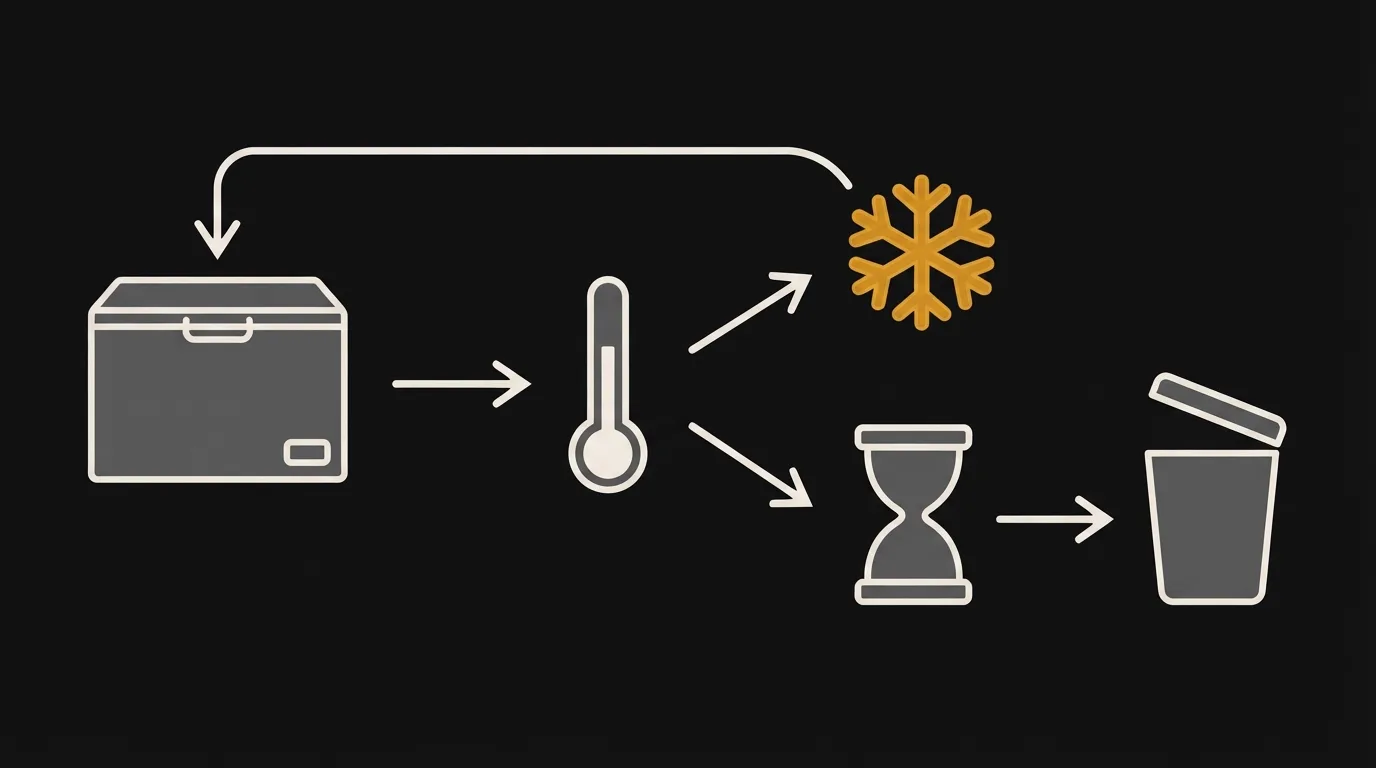
The test has two parts and either one is enough. If the freezer thermometer reads 40 or below when the power returns, everything inside can stay. If there is no thermometer, check each package: a roast that is still hard in the middle, or a bag of peas with ice inside, passes. A package that is soft all the way through and feels warmer than refrigerator-cold does not.
Ice cream is the one item MSU tells you to throw out even if it is cold and still has crystals. It is safe in principle, but the quality falls so far on refreezing that the agency does not recommend it.
Freezer food: what to keep and what to toss
Once a package has spent over two hours above 40 degrees, the answer depends on what it is. The FoodSafety.gov chart splits the freezer into foods that must go, foods that can be refrozen anyway, and vegetables, which get a longer window.
Throw these out:
- Beef, pork, lamb, poultry, ground meat, fish and shellfish
- Soups, stews and casseroles, including pasta and rice dishes
- Milk, eggs out of the shell, soft and shredded cheese, cheesecake
- Ice cream and frozen yogurt
- Frozen dinners, pizzas, meat pies and breakfast sandwiches
- Cakes, pies and pastries with custard or cheese filling
- Vegetables and vegetable juice once they pass six hours above 40
Refreeze these:
- Hard cheese
- Bread, rolls, muffins and cakes without custard filling
- Pie crusts and bread dough, with a loss in quality
- Flour, cornmeal and nuts
- Waffles, pancakes and bagels
- Fruit and fruit juice
The pattern is easy to remember once you see it. Foods with protein and moisture, the things bacteria grow in, have the two-hour limit. Dry, starchy and acidic foods tolerate warmth far better. Fruit and fruit juice may be refrozen even after a warm spell, though the chart says to discard them if mold, a yeasty smell or sliminess appears. Vegetables sit in between. Pie crusts and bread dough can go back in the freezer, though the chart warns the quality loss is considerable.
For a household that buys a side of beef or puts up a summer's garden, this chart matters more than any other on the subject. A freezer that warmed past 40 overnight may still give back the bread, the berries and the bag of flour you moved there to keep the weevils out, while the meat is the loss.
The refrigerator runs out first
A refrigerator gets about four hours, and in a long outage it is where most of the waste happens. Ready.gov says to throw away any food exposed to 40 degrees or higher for two hours or more, or that has an unusual odor, color or texture. The FoodSafety.gov list of what must go after that point includes raw and cooked meat, lunch meat and hot dogs, milk, yogurt and soft cheeses, eggs, cooked pasta and rice, opened spaghetti sauce, creamy dressings and leftovers of every kind.
More of the fridge survives than people expect. Butter and margarine, hard and processed cheeses, peanut butter, jelly, mustard, ketchup, pickles, olives, soy and barbecue sauces, vinegar dressings, opened fruit juice, raw vegetables and whole fresh fruit are all marked safe after the same warm spell. Opened mayonnaise gets until it has spent eight hours above 50 degrees. NDSU puts it simply: high-acid foods such as ketchup, mustard, pickles, jams and jellies are typically safe, though they may spoil sooner.
Medicine is the item with the most at stake. Ready.gov's rule is that if the power is out for more than a day, you discard any medication that should be refrigerated unless its label says otherwise, and get a new supply from a doctor or pharmacist. Anyone who depends on insulin or another refrigerated drug needs a cooler plan written down before the storm, along with the pharmacist's answer on how long that drug tolerates room temperature.
Cook it now, or hold it cold?
Somewhere around the second day, a long outage forces a choice. The freezer is warming, the meat is softening, and you can either fight to keep it frozen or cook it while it is still safe. Cooking is often the better use of the food. Meat that has thawed but stayed at 40 degrees or colder is safe to cook, and cooking it on day two turns a looming loss into several meals.
Plan to eat or chill the result quickly, because cooked food left at room temperature has the same two-hour limit as raw. Plan meals for the people you are feeding over the next day, not a pot of stew big enough to need a working refrigerator. A gas grill, camp stove or charcoal grill works for this, used outdoors only. Ready.gov says these belong at least 20 feet from windows and never indoors, and our guide to generator and carbon monoxide safety covers the same distances for a generator. A household with a wood heater can cook on top of it, and our page on cooking on a wood stove explains how to use the hot and cool zones.
Two shortcuts are unsafe at any point. Cooking does not rescue food that has already passed the two-hour limit, because MSU Extension notes that perishable food held too warm may cause illness even when thoroughly cooked. And the gas oven or stovetop is never a space heater, which Ready.gov singles out because of carbon monoxide.
Why the sniff test fails
The old habit is to open the package, smell it, maybe taste a corner, and decide. MSU Extension explains why that does not work. Refrigerated food carries two kinds of bacteria. Spoilage organisms make food smell and taste off, while the pathogenic ones that make people sick do not make their presence known. They cannot be seen, smelled or tasted.
A chicken breast can smell perfectly normal and still be dangerous after a warm night, and a sour smell can come from bacteria that would not harm you. Smell is useful in one direction only: if something smells bad, throw it out. If it smells fine, that tells you nothing about safety, and the decision goes back to time and temperature. NDSU says it directly: tasting food that may be unsafe is not a good plan.
When the power comes back
Read the thermometers before you open anything else. Write down what they say, then go through the freezer package by package with the chart above, starting with meat and fish. When you are unsure how long something was warm, the rule every agency repeats applies: when in doubt, throw it out.
MSU Extension recommends cleaning and sanitizing the freezer before restocking, defrosting first if the manufacturer's directions call for it, and making sure it is back down to 0 degrees before you load refrozen food. Bag the discarded meat well and get it out of the house before it starts to smell.
Then add up the loss. CSPI notes that some homeowner's insurance policies and some power companies cover food spoiled in an outage, so a list of what you threw out, with a photo or two, is worth making before the trash goes to the curb.
Set up the freezer before the storm
Almost everything that decides how a freezer comes through an outage is settled before the power fails. Keep it as full as you can, filling gaps with frozen water bottles. Leave a thermometer inside where you can read it at a glance. Freeze a few containers of water to move to coolers, and know where you would get dry ice. Group food tightly together, since a packed block holds cold longer than packages scattered across the shelves.
A generator changes the arithmetic, because it lets you bring the freezer back down to 0 degrees before the 24 or 48 hours run out, with the thermometer telling you when it has. Before relying on one, read our generator safety guide on placement, cords and fuel.
Finally, think about how much of your food supply depends on electricity at all. A freezer full of meat is a fine part of a household store, but it is the part most exposed to a long grid failure. The canned meat, dry beans and rice in our food storage shelf life chart need no power to keep, and our plan for three months of food for a family of four is built mostly on them.
My take: what I'd do
I'd put an appliance thermometer in every freezer and fridge in the house this week, because every decision on this page hangs on a reading most families never take. I'd keep the chest freezer packed, with frozen jugs of water taking the place of food as it gets eaten.
During an outage I'd leave the lid shut for the first day, move the refrigerator's meat and milk into coolers early, and plan to cook the softest meat on day two outdoors on a grill rather than gamble on day three. And I'd keep the freezer as the convenience layer of the pantry, with the food a family would actually live on in a long outage stored in cans and buckets on a shelf.
Sources
- Ready.gov: Power outages
- Michigan State University Extension: Keep or toss? How long food lasts in the freezer during a power outage
- North Dakota State University Extension: Keep food safe during power outages
- Center for Science in the Public Interest: Food safety during a power outage (FoodSafety.gov charts)
- USDA: Winter storm preparation and food safety, January 2026
