Food storage
Aluminum Foil for Food Storage
Safe for a few days in the fridge, useful in the freezer, and the wrong material for anything you mean to keep for years.
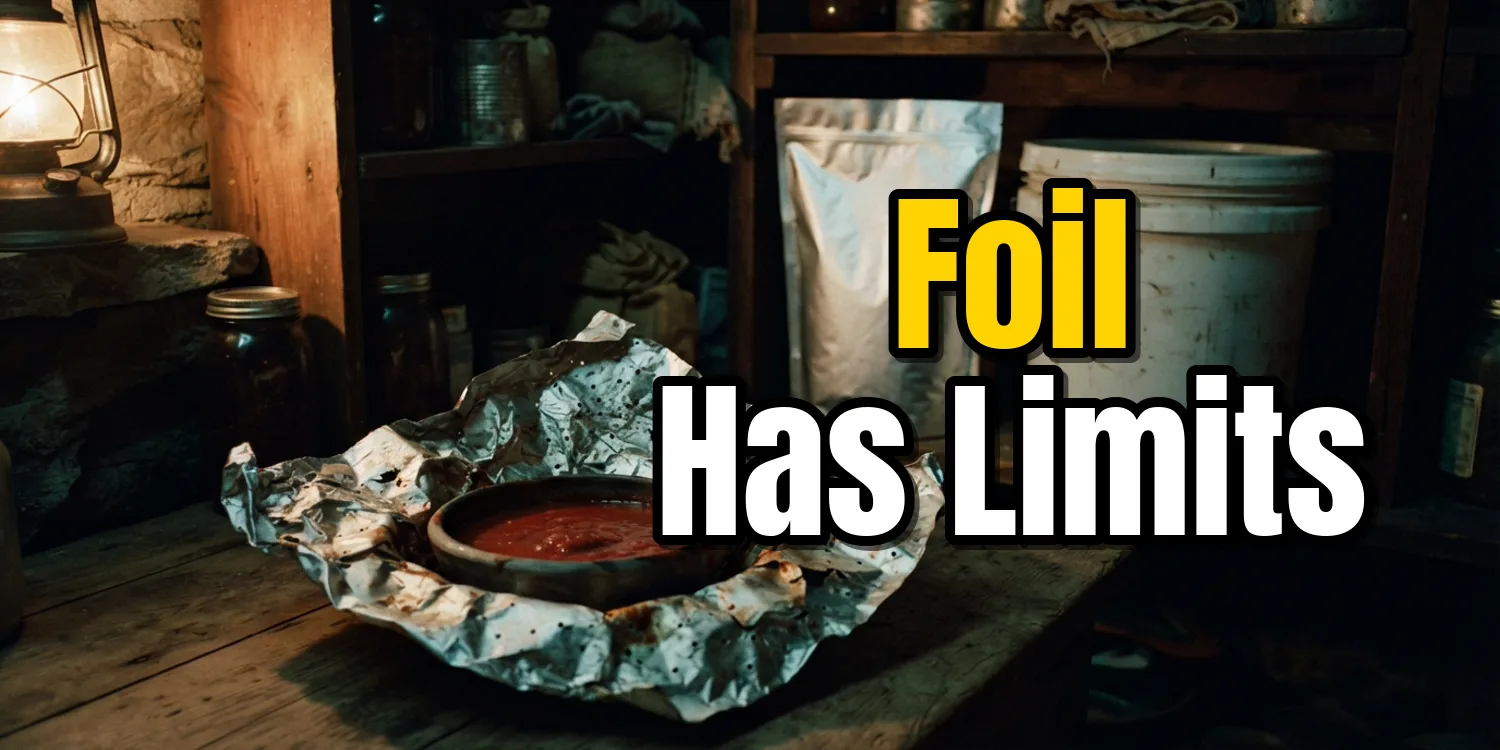
Aluminum foil is safe for wrapping cold leftovers in the refrigerator for the usual three to four days, and heavy-duty foil works as a freezer wrap for dry food. It fails as storage for acidic or salty food, for warm food left on the counter, and for anything meant to sit in a pantry for months or years, where only a heat-sealed Mylar bag or a can keeps air, moisture and pests out.
If you found this page because you are deciding how to put away a pot of chili tonight, the short version is in the first two sections. If you are trying to stretch a few rolls of foil into a long-term food store, the answer is no, and the last half of this page explains why and what to buy instead.
See the Mylar and bucket packing method
Is aluminum foil safe for storing food?
For ordinary kitchen use, yes. The USDA Food Safety and Inspection Service treats foil as a normal food wrap, and its packaging fact sheet says that pinholes in foil or a blue liquid that may form on the food are not harmful. The residue is an aluminum salt, the same family of compounds sold in some antacids.
The more cautious voice comes from Germany. The Federal Institute for Risk Assessment (BfR) studied how much aluminum people take in from every source at once: food, cookware, cosmetics, packaging. It found that some groups can exceed the European tolerable weekly intake, and it advises against preparing and storing food in uncoated aluminum foil, particularly acidic or salty food. The BfR names children who often eat food packed or kept warm in foil and aluminum trays as one of the groups to watch.
Those two positions fit together better than they look. A single meal that touched foil is no emergency. Making foil the daily wrap for tomato sauce, pickles and salted meat is a habit the BfR would have you drop, because it adds aluminum you could easily avoid.
Can you store leftovers in foil?
You can, and the food-safety clock is the same one that applies to any container. Illinois Extension's leftovers guidance sets it out plainly: get food into the refrigerator or freezer within two hours of serving, use refrigerated leftovers within 3 to 4 days, and frozen ones within 3 to 4 months. Reheat to 165°F. Foil does not lengthen any of those times.
Where foil falls short in the fridge is the seal. A crimped edge is never airtight, so leftovers dry at the surface, pick up onion and fish smells from the shelf, and leak juice when the package tips. For anything wet, a lidded glass or plastic container does the job better. Foil is at its best over a casserole dish or wrapped tight around a solid piece of cooked meat.
A few habits make foil leftovers safer and easier to manage:
- Split big batches into shallow portions so they cool fast, then wrap.
- Write the dish and the date on a strip of masking tape on the foil.
- Keep foil packages on an upper shelf, above raw meat.
- Throw out a package that has torn open and dried, even inside the 4 days.
What acidic and salty food does to foil
Anyone who has pulled foil off a pan of lasagna and found it eaten through in polka dots has seen the reaction. Acid and salt attack the thin oxide layer that normally protects aluminum, the metal dissolves where the food touches it, and you get pinholes, gray flecks on the cheese, and sometimes a metallic taste.
Chemist Ghada Bassioni and colleagues measured how much aluminum moves into food wrapped in foil. Writing about that work, she reports that leaching was much higher in acidic liquids such as lemon and tomato juice, and higher again when spices were added, and that heat speeds it up. Her conclusion for cold food is measured: wrapping cold food in foil is fine, though not for long stretches, because the metal keeps dissolving into acidic or spiced food as long as they touch.
The foods to keep off bare foil, in the fridge or out of it:
- Tomato sauce, salsa, chili and anything braised in tomatoes
- Citrus, citrus marinades and vinaigrettes
- Pickles, sauerkraut, kimchi and other brined vegetables
- Rhubarb and sour fruit compotes
- Salt-cured ham, bacon, salt fish and heavily salted dry rubs
The workaround costs nothing. Put a sheet of parchment or plastic wrap against the food and use the foil as an outer layer, or move acidic leftovers into glass. A cured ham hanging in a cool room does better in a cotton bag or butcher paper, which the salt cannot eat through. Our guide to preserving meat without refrigeration covers that wrapping in more detail.
Warm food in foil on the counter
This is the one foil mistake that has put people in the hospital. A baked potato wrapped tight in foil and left to cool on the counter is a sealed, low-oxygen, moist package sitting in a warm kitchen, which is what the bacteria that cause botulism need. Potato skins carry their spores from the soil, and baking does not destroy them. A study in the Archives of Internal Medicine traced a large 1994 botulism outbreak in El Paso to foil-wrapped baked potatoes held at room temperature and later used in a dip.
The fix is simple. Unwrap baked potatoes once they come out of the oven or off the coals, eat them hot or refrigerate them within two hours, and never leave foil-wrapped food sitting out overnight. That goes double for camp cooking and grid-down meals cooked in foil packets on a fire, where the leftovers are easy to forget beside the pit. Any cooked food that spent the night in foil on a counter or a picnic table goes in the trash.
Using foil in the freezer
Freezing is where foil does respectable work. The National Center for Home Food Preservation lists heavy-weight aluminum foil among the wraps suitable for dry-packed food with little or no liquid, alongside plastic freezer wrap and freezer paper. The word that matters is heavy-weight. Regular kitchen foil tears on a frozen corner and lets in the dry freezer air that causes freezer burn.
Wrap the food snug, press out the air, fold the seams twice, and then slide the package into a freezer bag. The foil hugs every corner of a roast or a loaf, and the bag protects the foil from punctures when you dig through the chest. Leave soups, stews and anything saucy out of foil entirely. They belong in rigid containers with headspace, and many of them are acidic anyway.
A freezer full of foil packages also has one weakness that matters on this site: it depends on the power staying on. When it does not, our guide to what to keep, cook or throw out when the freezer loses power takes over, and the wrapping makes no difference to that decision.
Why foil fails for long-term pantry storage
Some preppers wrap rice, jerky, crackers or flour in foil and put them on a shelf, reasoning that it blocks light and air. It blocks light. It does almost nothing about air, moisture or pests over months, for four reasons.
It cannot be sealed. A folded or crimped seam always leaves channels for air. Long-term storage depends on getting the oxygen out and keeping it out, which is the job of a heat seal or a can lid, and foil can hold neither.
It cracks where it bends. Every crease in thin foil is a weak spot, and handling a package a few times opens pinholes along the folds. Once that happens, humid air reaches the food, and dry food that takes on moisture can grow mold.
It does nothing against mice and insects. Mice chew straight through foil, and pantry moth larvae crawl in through the smallest gap at a fold. A sealed bag inside a lidded food-grade bucket is the standard answer because the bucket stops teeth and the bag stops air.
It cannot work with an oxygen absorber. An absorber in a foil package simply pulls in more room air through the seams until it is spent. In a sealed Mylar bag the same absorber shrinks the bag down around the rice or beans, a sign that the oxygen is gone. Our oxygen absorber calculator sizes them for a bag, a jar or a bucket.
Salty and acidic dried foods add a fifth problem: they keep pitting the foil the whole time they sit in it. For the full list of ways a stockpile goes bad before anyone opens it, see the storage mistakes that quietly ruin a stockpile.
Foil vs Mylar for long-term storage
The confusion is understandable, because a Mylar food-storage bag looks like heavy foil. It is a different material. The bag is a laminate: layers of polyester and plastic film with a thin metal layer between them. The food touches plastic, the metal layer blocks light and gas, and the inside layer melts under a hot iron or an impulse sealer into a seam that air cannot cross.
Side by side, the two differ on the points that decide how long food keeps:
- Light: both block it.
- Seam: foil is only folded, while a Mylar bag is heat-sealed shut.
- Oxygen: air seeps back into foil, and a sealed bag with a sized absorber keeps it out for years.
- What touches the food: bare aluminum in foil, a plastic inner layer in Mylar.
- Handling: foil cracks along its creases, and the thicker bag film flexes.
- Mice: they chew through both, so the bag needs a bucket around it.
- Useful life: weeks to a few months for foil, decades for dry staples in Mylar.
For rice, beans, wheat, oats and pasta, the packing that works is a Mylar bag inside a food-grade bucket, an oxygen absorber sized to the bag, and a cool spot in the house. Our guide to packing rice, beans and wheat for decades walks through the bags, the sealing and the absorbers step by step, and the shelf life chart shows how long each staple keeps once it is packed well.
The one thing Mylar shares with foil is that it cannot fix wet food. A sealed, oxygen-free bag of anything moist is the same low-oxygen danger as the foil-wrapped potato, which is why only snap-dry food goes in.
Where foil still earns its place on the shelf
A few rolls of heavy-duty foil belong in a household supply, for cooking more than storing. In an outage it lines a pan on the grill, wraps vegetables or fish for the coals, covers a pot to save fuel, and keeps a dish warm for the half hour before dinner. On a wood cookstove it shields food that is browning too fast, and our page on cooking on a wood stove covers the heat zones where that matters.
For those jobs, the rules above still hold. Keep acidic food off bare foil when you cook it, unwrap packets once they come off the heat, and get whatever is left into a cooler or fridge before the evening is out.
My take
I'd keep foil in the kitchen drawer and out of the storage room. If you are starting a food store from scratch, I'd start with a box of Mylar bags and a pack of absorbers before buying another roll of foil. For leftovers, I'd pick lidded glass first because it seals, does not react with tomato or vinegar, and goes from fridge to oven. Foil earns its place as a freezer overwrap around meat and bread and as a cooking tool on the grill or the stove.
For the food you are counting on in a long outage, skip foil completely and spend the money on Mylar bags, absorbers and a few food-grade buckets. A roll of foil costs less than a box of bags, but it protects food for weeks, and a sealed bag in a bucket protects it for decades.
See the Mylar and bucket packing method
Sources
- USDA Food Safety and Inspection Service: Meat and poultry packaging materials
- University of Illinois Extension: Leftovers
- National Center for Home Food Preservation: Containers for freezing
- German Federal Institute for Risk Assessment (BfR): Reducing aluminium intake can minimise potential health risks
- Ghada Bassioni, The Conversation: Why you shouldn't wrap your food in aluminium foil before cooking it
- PubMed: A large outbreak of botulism, the hazardous baked potato
